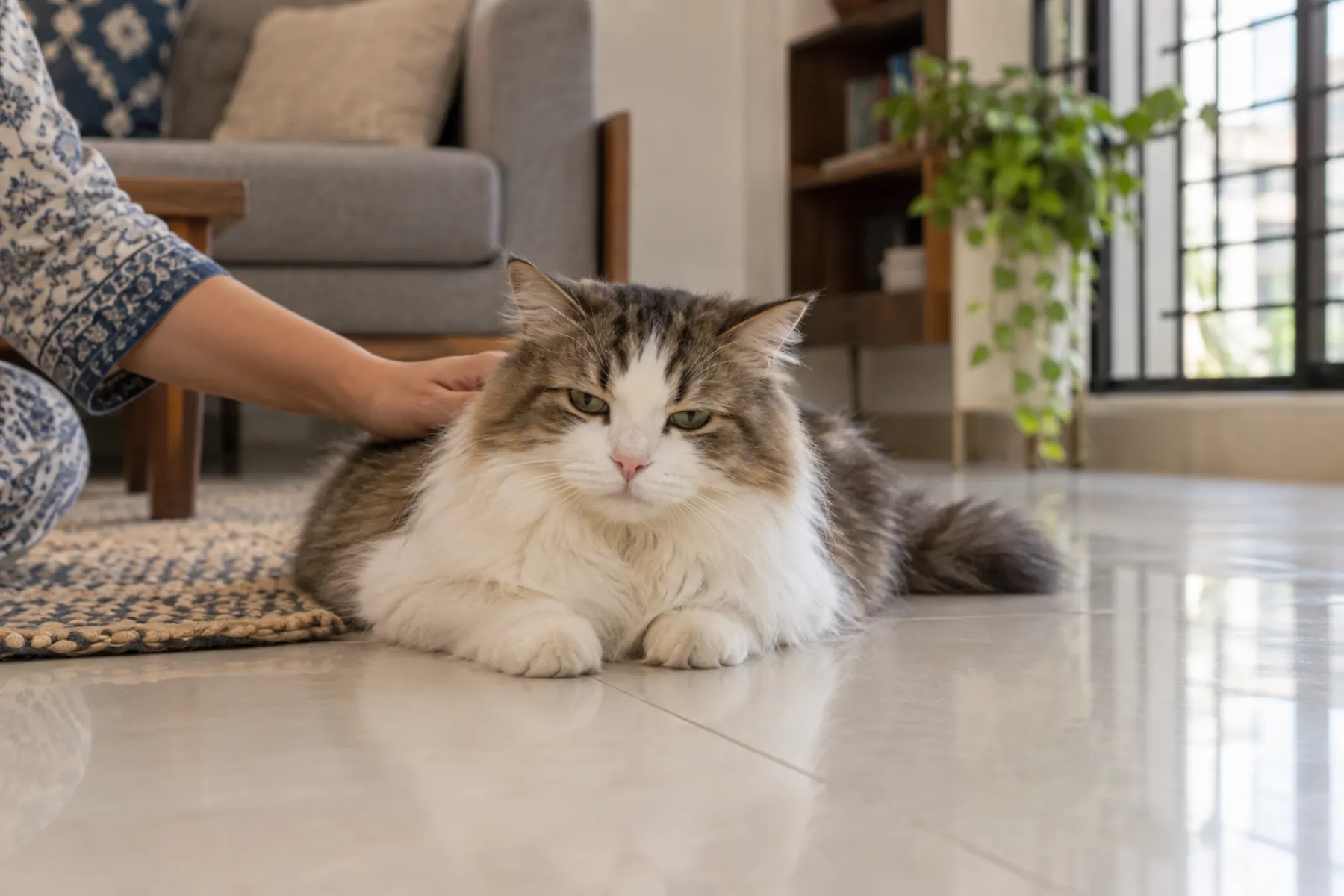
A sign, not a disease. Change is what matters
Cat vomiting is a sign, not a disease, and the thing most worth watching is change. A cat that rarely vomited and has now done it twice in one month needs a vet to look, even if both times looked like hairballs. As a working rule, twice a month or more, hairballs included, is worth getting checked.
A single vomit in a cat who is otherwise bright, eating, drinking and using the litter tray normally can usually be watched at home for a day. Go to a clinic now if there is blood in the vomit, if your cat is retching and bringing up nothing, if you can see thread or string in the mouth, if the belly looks swollen or tense, if your cat is struggling to breathe or has stopped eating and drinking, or if a male cat is also straining in the tray.
The harder message sits underneath that list. The concerning cases rarely look dramatic: bile and fluid alongside the hairballs, which everyone at home stopped noticing long ago, sometimes including the vet.
“When a cat starts vomiting more often and is also grooming a lot, the pet parent's first knee-jerk reflex is to put it down to over-grooming and more hairballs,” says Dr. Vikas Godara, who reviewed this article and has seen that assumption hide real disease “not one but many” times.
Why is my cat vomiting?
Vomiting is the stomach acting as a messenger. The message is only ever “something is wrong somewhere”, and which somewhere is the part you have to work out. In cats it splits into two broad places, and knowing which one you are in changes what happens next.
The gut itself. Something swallowed, inflamed, blocked or growing. Food that disagreed. Worms. A length of thread from a kurta hem.
Everywhere else. Failing kidneys, an overactive thyroid, an inflamed pancreas, a sick liver, diabetes. Waste or hormones in the blood reach the brain, and the brain orders the vomit. The stomach can be perfectly healthy.
Is it vomiting, a hairball, or regurgitation?
Three different events, routinely described with the same words at the reception desk. Sorting them is the first thing a vet does.
There is a run-up: the cat goes quiet, crouches low, the flanks pump and the belly heaves several times before anything appears. What comes up is partly digested, often with yellow bile.
No heaving, no warning. Food simply falls back out, undigested and sometimes tube-shaped, often right after a meal. Cats that bolt their food do this a lot.
A cat bringing up a cigar-shaped plug of fur has done the full heave and simply had fur in the stomach when it did.
And here is the part owners miss. Hair in the vomit does not make it a hairball. Every cat has swallowed fur sitting in the stomach, so a cat vomiting for a completely different reason will still bring some up.
“If the content is not just the hairball, but hairball with some bile or gastric acid, and it is followed by another vomiting episode, that is more concerning,” Dr. Vikas says. “When the cat vomits due to gastritis or another underlying cause, the hairball could still be present in the vomitus.”
What have you noticed?
It will help choose the safest next step. Select everything that applies to your cat right now.
- Select what applies to your cat. Your safest next step will appear here. This check cannot diagnose your cat; it sorts the harmless from the serious.
- Reasonable to watch at home today. No food for four to six hours, water left down the whole time, then plain broth or soft food. Settling over the evening is reassuring. Repeating, or a cat going quiet and hiding, is not.
- Worth a vet's look. Book a video consultation. A pattern, or hair mixed with bile, is where you stop explaining it away. Have a photo of the vomit, a rough count for the month and when it happens against meals ready.
- Speak to a veterinarian today. A cat with swallowed thread can look well for a while before it becomes an emergency, and a cat that has stopped eating for about a day is at risk of liver problems. Do not wait for tomorrow.
- Go to a physical veterinary clinic now. An emergency sign is selected. Do not wait for an online appointment, do not try to make your cat vomit, and do not pull any thread you can see.
When it happens tells you something
Owners can report this at home, and it narrows things down fast. It is one of the first things Dr. Vikas asks on a call, right after what came up and how long it has been going on. Choose the timing that matches your cat.
Often regurgitation
Food falls back out undigested, sometimes tube-shaped, with no heaving. Cats that bolt their food do this a lot. What the food looks like is what decides it.
- Right after eating. Often regurgitation. Food falls back out undigested, sometimes tube-shaped, with no heaving. Cats that bolt their food do this a lot. What the food looks like is what decides it. What to do now: Slow meals down with smaller portions or a puzzle feeder. If it keeps happening, or weight is coming off, get it checked.
- 30 minutes to an hour after. Significant inflammation in the stomach. The cat cannot hold food down. The question that follows is whether water stays down. What to do now: If water stays down, rest food for four to six hours and then try plain broth. If even water comes back up, call a vet now.
- Four to six hours after. The intestine may be involved. Partly digested food this long after a meal can point to longer-running inflammation lower down the gut. What to do now: This is a vet question rather than a home one. Book a consultation and bring the timing and what came up.
- Empty stomach, early morning. Bile, from bilious vomiting syndrome. A yellow puddle at 6 a.m. in a cat that is otherwise thriving means something different from the same puddle in a cat that has been losing weight since Diwali. What to do now: A small late-night meal settles a lot of these. If it keeps happening, or your cat is losing weight, get it checked rather than managed.
Timing alone doesn't diagnose anything. In Dr. Vikas's words, it “has to be correlated with the overall content of the vomitus and factoring in all the previous history”.
“It's just a hairball”
Every cat swallows fur. Grooming is most of what a cat does when it is not asleep, the tongue is covered in backward-facing hooks that pull loose hair down the throat, and some of it has to come back out. So far, so normal.
The question is how often, and here the honest answer is more useful than a single number. Cornell's Feline Health Center says a cat vomiting more than once a week should be seen. The research group that has looked hardest at chronic vomiting draws the line tighter, at twice a month, hairballs included.
Dr. Vikas doesn't use either as a hard line. “It's very tricky to just put one number,” he says. “I do not draw any line in practice. Everything has to be based upon the entire context of the patient.”
What he watches is change. “A cat that never had a vomiting episode, but now she had two vomiting episodes in one month, that itself is a flag to get it checked.” And the reverse holds too: an anxious cat that over-grooms and brings up pure hairballs three or four times a month can still be within normal. Twice a month is where you stop explaining it away and let a vet decide which of those two cats you have.
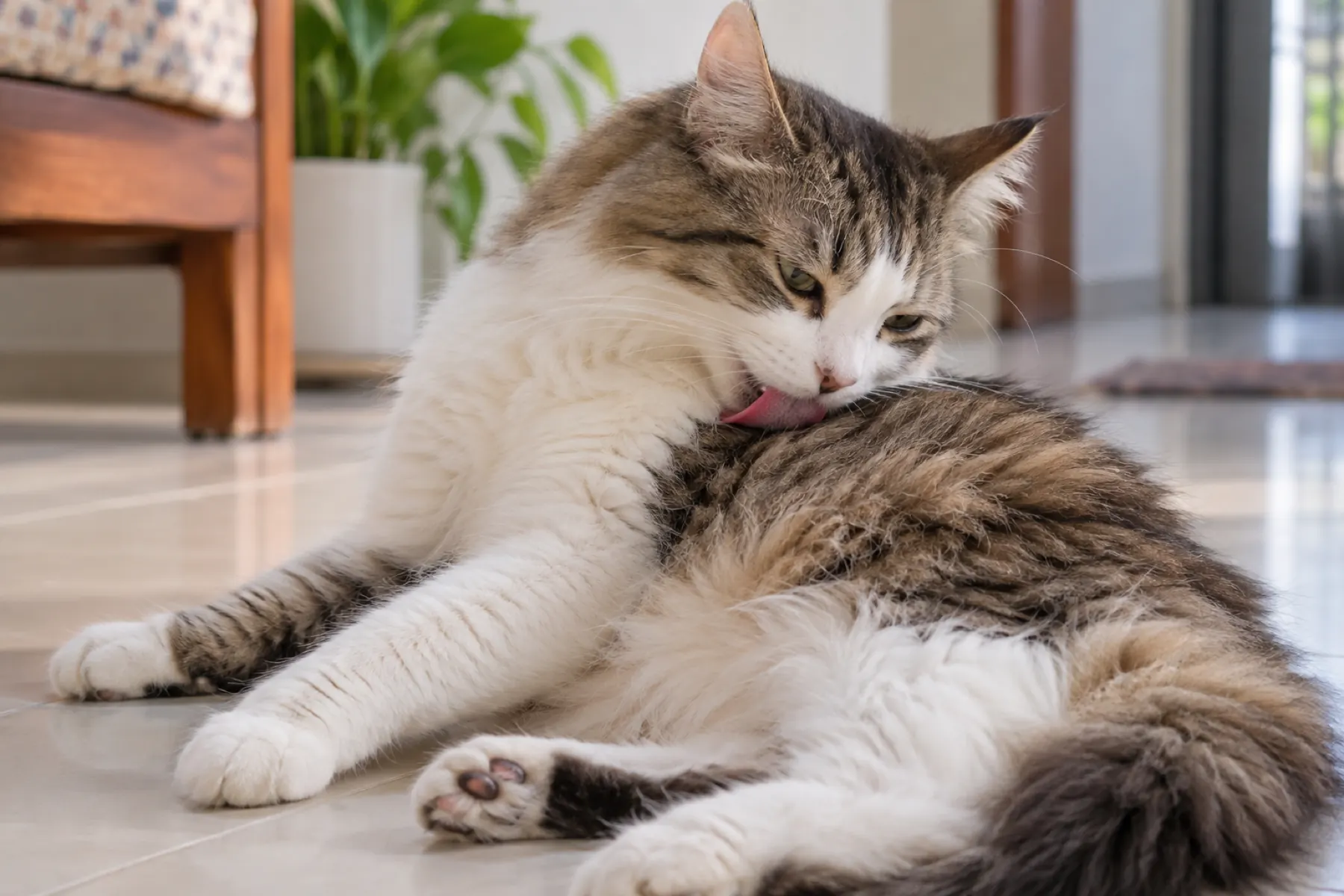
Hairball gels, which a lot of Indian homes give, are not the problem. “They do help,” he says. The problem is filing every episode under fur.
What the research actually found
This is where most articles on cat vomiting either stop short or overstate.
A team led by Gary Norsworthy took 100 cats that had two things at once: persistent signs (vomiting at least twice a month, weeks of small-bowel diarrhoea, or half a kilo of weight lost in six months) and a thickened small intestine on ultrasound. Every cat had surgical biopsies. The 2013 results: 99 of the 100 had intestinal disease. Chronic enteritis in 49, intestinal lymphoma in 46, mast cell disease in 3, adenocarcinoma in 1.
A larger follow-up in 2015 found confirmed disease in 288 of 300 cats (96%): chronic enteritis in 150, lymphoma in 124. Median age, fourteen.
Read that precisely. It describes cats with persistent signs and a thickened bowel on the scan and families who agreed to surgery. It is not 99% of all vomiting cats. What it does show, with real force, is that once a cat has been vomiting for months and the scan shows a thickened bowel, the chance of finding nothing is very small.
The detail that ought to change behaviour is buried in the first paper. Twenty-six of those 100 cats came in for a routine wellness check. Nobody brought them for vomiting. Their families had filed it under normal.
What that looks like in a real cat: Max
Dr. Vikas saw the same pattern in his own practice in the United States.
| The cat | Max, nine years old, neutered male, a long-time patient |
|---|---|
| The history | Vomiting “about once or twice a week… nothing crazy, and mostly it’s hairballs”, for more than a year |
| The owner’s explanation | Max had been scratching more, so licking more, so more hairballs |
| What changed | The vomiting got more frequent over one to two months |
| Annual blood work | Nothing flagged. “There was nothing screaming out on the blood work.” |
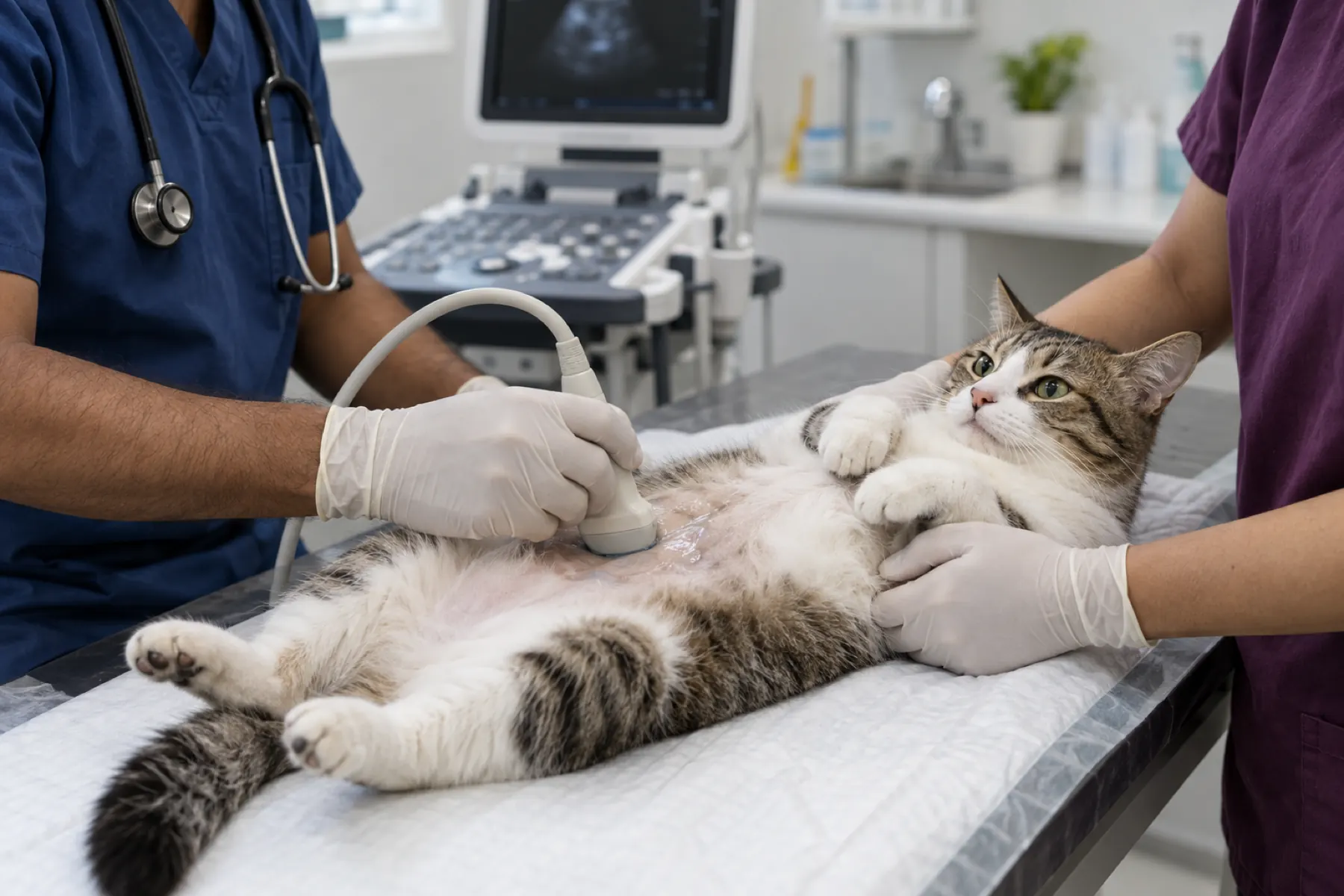
| Abdominal ultrasound | Swollen lymph nodes in the abdomen, especially around the intestine |
| Second opinion | Images and a short video clip sent to a radiologist: possible early lymphoma |
| Confirmation | Lymph-node sampling at a specialty centre: small cell lymphoma, very early stage |
| Now | On a chemotherapy protocol and doing fine, 17 months after diagnosis |
Look at the second row. Once or twice a week is four to eight times the research line, and it was described, sincerely, as nothing crazy. Now look at the fifth. Normal bloods did not clear this cat. The ultrasound did the finding.
The honest counterweight
There is a real argument against reading those studies too hard. In 2019 a group led by Sina Marsilio biopsied 20 cats that were clinically healthy. Twelve came back with findings consistent with small cell lymphoma, six looked like lymphocytic enteritis, and 17 of the 20 showed no signs of gut disease almost two years later.
So an abnormal biopsy in a cat doesn't automatically mean a sick cat. Norsworthy replied citing more than 700 biopsied cats of his own, and pointing out that the two groups used different techniques: full-thickness surgical samples in his work, shallower endoscopic ones in theirs.
Cat vomiting in Indian homes
Most of what ranks for “cat vomiting” is written for American or British cats. The commonest causes in Indian homes are different, and most of them sit in the kitchen.
Food from the family plate. Milk, curd, dal-chawal, fish, chicken, treats. “Very, very common,” he says. Over months, this long-term dietary indiscretion is what he sees most, and it leads to clinical or subclinical pancreatitis. After that come chronic diseases such as kidney disease.
Vegetarian diets. This is the one he singles out. “In Indian households that are vegetarian, families often think their pet also needs to be on a vegetarian diet. There are religious aspects to it too. That is the biggest thing we are seeing.”
Cats are carnivores, and their gut is built for it. On a long-term vegetarian diet he sees cats short of essential vitamins, including the B vitamins, short of protein, short of essential fatty acids, and showing it: thin, in poor body condition, coat unkempt.
He doesn't lecture families about it. He explains why a cat's body needs what it needs, holds his position, and offers a practical way through: a balanced commercial cat food, which also solves the problem for families who won't cook meat at home. If a family stays strictly vegetarian, he asks them to keep the diet as balanced as they can, while being clear that “there is no vegetarian diet per se that would provide all the essential minerals and nutrition and macronutrients required”.
Thread, string and small toys. Sewing thread, rakhi, hair ties, tinsel, children's toys. He rates these “very high risk in Indian households in comparison to US households”. More on why in the emergency section.
Community and outdoor cats. A lot of Indian cats come and go, or are community cats who visit. Scavenging, hunting and worms are real, everyday exposures, and deworming belongs on the same visit as vaccination.
The causes worth knowing
Inside the gut
- Eating too fast. The commonest harmless cause, especially where cats compete at one bowl. Food comes up whole, minutes later, and the cat is immediately looking for more.
- A sudden change of food. Gut bacteria need about a week to adjust.
- Food intolerance, which in cats usually shows as vomiting rather than itchy skin.
- Worms, still widely under-treated, especially in cats with outdoor access.
- Chronic enteritis and intestinal lymphoma, the two conditions behind most long-running vomiting in middle-aged and older cats.
- Obstruction. Repeated vomiting, nothing staying down, and a cat getting worse rather than better.
Outside the gut
Kidney disease. One of the commonest problems of older cats, and vomiting is one of its later signs. A cat that is also drinking more, urinating more and losing weight needs a blood and urine test, not a wait-and-see. Our guide to chronic kidney disease in cats covers why last year's normal report proves less than it seems.
An overactive thyroid. A cat eating well, even greedily, and still losing weight, often restless at night, with vomiting in the mix. Treating the thyroid can also reveal kidney disease that was hidden underneath it.
Pancreatitis, which in cats is frustratingly vague, and which can turn up at any age. Take Doobie.
| The cat | Doobie, two years and four months, female, not spayed, an Indie cat in India |
|---|---|
| Situation | About two months after giving birth and still nursing. Mostly outdoor, so nobody could watch her stools |
| The history | Vomiting that settled for a month or two, then came back. The cycle had run for five to six months |
| Why she came in | The vomiting was getting more frequent, and she was losing weight |
| Blood work | Pancreatic enzymes borderline, so a feline-specific pancreatic lipase test was run: pancreatitis |
| Ultrasound | Run because cats can get inflammation of the pancreas, liver and intestine together. It found inflammation of the common bile duct |
| Outcome | Responded really well to standard pancreatitis treatment. Now managed on a low-fat diet and probiotics |
“Her age definitely makes you less suspicious for lymphomas, but pancreatitis can happen at any age,” Dr. Vikas says. The catch is that young, otherwise healthy cats are exactly the ones that don't get worked up. “Not everyone would go for the detailed diagnostics.”
Liver disease and diabetes belong on the list too, and both are found the same way: a blood test.
Poisons
Cats process many substances differently from dogs and from us.
- Human medicines. Common household painkillers and fever tablets are among the most lethal poisonings in cats, and one tablet can be fatal. That includes leftovers from a previous illness, and anything a vet gave the dog.
- Things they walk through. Antifreeze, phenol-based floor cleaners and insecticides, picked up on paws and coat and then groomed off.
- Lilies. Plant poisoning is less common in India, in Dr. Vikas's experience, but true lilies and daylilies are fatal when it happens. Every part is toxic, including the water in the vase, and treatment within about 48 hours carries a good chance.
Go to a physical veterinary clinic now if
Do not watch these overnight, and do not wait for an online appointment first.
- There is blood in the vomit, fresh red or dark like coffee grounds
- Your cat is struggling to breathe, or breathing with visible effort
- The gums look pale, or yellow
- The belly looks bloated or swollen, or your cat objects to being touched there
- Your cat is severely lethargic, or lying on its side and unable to get up
- Your cat is retching again and again and producing nothing
- You can see thread, string, tinsel or ribbon in the mouth or under the tongue. Do not pull it
- Your cat has vomited more than two or three times in a few hours, stopped eating and drinking, or can't keep even water down
- A male cat is straining in the litter tray, crying, or passing nothing
- You know or suspect a human medicine, lilies or any poison
- Your cat is a kitten, is pregnant, or has a known heart, kidney or thyroid condition
The first five are exactly the signs Dr. Vikas watches for on a video call, and any one of them ends the call with a clinic referral.
The string: a swallowed length of thread catches at one end, very often around the base of the tongue, while the rest travels on, and the intestine gathers along it like a curtain on a rail. Pulling it is the worst possible move. Rakhi, sewing thread and hair ties are everywhere in Indian homes, and Dr. Vikas rates the risk far higher here than in the US.
The litter tray: a male cat straining and producing nothing is the most misread emergency in cats. Families read it as constipation and wait. A blocked bladder poisons the blood within hours, makes cats vomit, and is fatal within a day or two.
What to do at home after a single vomit
If your cat has vomited once, seems normal otherwise, and none of the red flags apply, this is what Dr. Vikas tells families. Work through the five steps in order.
Five steps, in order
Tap a step to see exactly what it means and where it stops being a home job.
No food for four to six hours. Not longer.
A short, deliberate rest for the stomach. Do not extend it on your own: a cat that goes without food for a couple of days can develop serious liver problems on top of whatever started this.
- Pause food. No food for four to six hours. Not longer.. A short, deliberate rest for the stomach. Do not extend it on your own: a cat that goes without food for a couple of days can develop serious liver problems on top of whatever started this.
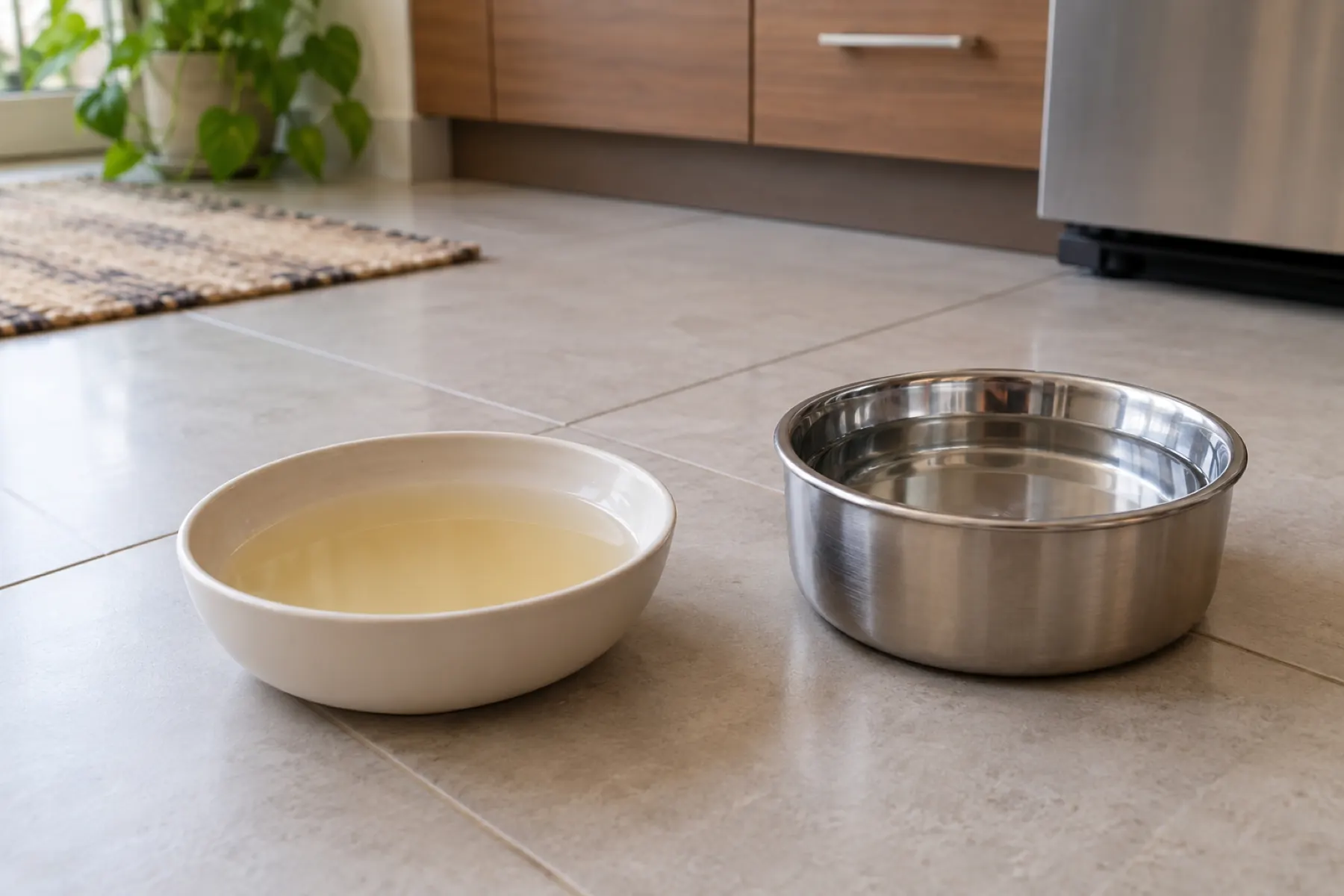
- Keep water down. Water stays down the whole time. “Water ideally should never be taken away.” If even water will not stay down, stop here and call a vet.
- Restart with broth. Plain broth or soft food first. “Boiled chicken broth, nothing else in it, or fish broth, but nothing in it.” No onion, garlic, salt or masala. A semi-solid food works too. Skip the dry kibble for now.
- Small bland meals. If that stays down, build back up. Small, bland portions, building back to a normal amount over the next day.
- Watch the trend. Direction of travel, and the litter tray. Settling over the evening is reassuring. Repeating, or a cat going quiet and hiding, is not. Check the tray: a male cat straining and passing nothing is a different emergency.
What an online vet can and cannot do for a vomiting cat
Most vomiting is not an emergency, and it doesn't need a drive across the city with a yowling carrier. It needs someone to sort the harmless from the serious. Here is how Dr. Vikas runs a video consultation for a vomiting cat.
He asks first
- What came up, and what colour it was. He calls this the most important thing.
- How long this has been going on.
- When it happens against meals, as in the timing guide above.
- Anything else you have noticed that seems to set it off.
He asks to see
- The whole cat, from several angles, to judge body condition.
- The belly. A bloated or swollen abdomen is a red flag on its own.
- The breathing. “If it's already looking dyspneic,” breathing with effort, “that is an emergency.”
- How the cat is holding up: bright and alert, quiet but responsive, or lying on its side.
- The cat walking.
If your cat is cooperative, he'll talk you through
- Lifting the lip to show gum colour.
- Capillary refill: pressing a thumb on the gum and watching the colour return.
- A skin tent test for dehydration.
- A gentle press on the belly while he watches for pain.
Don't force any of these on a frightened or fractious cat.
He stops the call and sends you to a clinic for
- Breathing difficulty
- Pale gums
- A bloated belly
- Severe lethargy
- Blood in the vomit
What still needs a clinic
- An X-ray or ultrasound
- Blood and urine samples
- Fluids
- Biopsy and surgery
A video call gets you to the right one faster.
What this costs in India
As of September 2026, a video consultation with a registered veterinarian on Vetezy starts at ₹499, and you get a written care plan afterwards.
For the hands-on side, these are Dr. Vikas's figures for the Chandigarh tricity (Chandigarh, Mohali, Panchkula) in September 2026:
| Test | Typical cost |
|---|---|
| Blood count and biochemistry | ₹800–1,000 |
| Blood panel with electrolytes | ₹1,200–1,500 |
| Urinalysis | ₹200–300 (up to ₹1,200 with culture) |
| Abdominal ultrasound | ₹1,500–2,000 |
| Feline pancreatic lipase test | about ₹400 |
| Cytology | ₹400–600 in-house, ₹600–800 at a reference lab |
| First workup as a package (blood panel with electrolytes, urinalysis, abdominal ultrasound) | ₹2,500–3,500 |
| Biopsy, including anaesthesia or sedation | ₹3,000–5,000 in tier-two cities, ₹5,000–7,000 in tier-one cities |
In Delhi NCR and Mumbai, expect roughly 1.5 to 2 times the tricity prices. Tests run in-house cost less than tests sent to a reference lab.
What's available where matters as much as price. Abdominal ultrasound and cytology are available in most tier-two cities now. A biopsy sample can be taken there too, but the histopathology is usually done by reference laboratories in tier-one cities, so results take longer outside the metros.
Frequently asked questions
My cat vomited once and is behaving normally. Should I worry?
Usually not. No food for four to six hours, water left down, then plain broth or soft food, then small bland meals. What decides it is the trend: settling is reassuring, repeating is not. Note the date, because a pattern only shows up if someone counts.
How often is too often for a cat to be sick?
There is no single safe number. Watch for change from your cat's normal. A cat that never vomited and now has twice in a month needs checking. As a rule of thumb, twice a month or more, hairballs included, is worth a vet's look, even if it turns out to be an over-groomer.
My cat vomits right after eating.
That is often regurgitation, especially in a cat that bolts its food. Slowing meals down (smaller portions, a puzzle feeder) often helps. Vomiting 30 minutes to an hour after food, or food coming up partly digested hours later, points to the stomach or intestine and needs a vet.
My cat throws up yellow liquid early in the morning.
That is bile on an empty stomach. A small late-night meal settles a lot of these. If it keeps happening, or your cat is losing weight, get it checked rather than managed.
Is it a hairball or something else?
A cigar-shaped plug of packed fur is a hairball, and it still counts. Hair mixed with yellow bile or stomach fluid, especially if another vomit follows, is more concerning: the hair was just in the stomach when your cat vomited for some other reason.
Can my cat be vegetarian?
Not safely. Cats are carnivores, and Dr. Vikas sees vegetarian-fed cats short of B vitamins, protein and essential fatty acids, thin and with poor coats. If cooking meat is not possible in your home, a balanced commercial cat food solves it.
Can I give my cat anything at home to stop the vomiting?
No. Nothing from a human medicine box is safe for a cat. Anti-sickness treatment for cats exists and works well, but the choice and dose are a vet's decision after finding the cause.
My cat swallowed a thread and seems fine.
Get seen today. A cat with swallowed thread can look well for a while before it becomes an emergency. If any is visible in the mouth, do not pull it.
Show a vet what came up
A photo of the vomit, a rough count for the month and when it happens against meals is most of the history. Bring them to a video consultation and leave knowing whether tonight is a watch-at-home night.
Talk to an expert
VCI Reg. No. 7503 · HVC Reg. No. 2649 · Member, AVMA (#323100) & CVMA (#49706) · USDA-accredited veterinarian · 11+ years in small animal medicine and surgery.
The cases, quotes, video-call method and cost figures in this article come from his own practice in India and the United States. No owner is identified.
Dr. Vikas Godara's profile The veterinarian behind VetezyThis content is for general educational purposes and does not replace a veterinary examination, diagnosis, or treatment. If your pet shows emergency signs or is seriously unwell, contact a physical veterinary clinic immediately.
Clinical references
- Norsworthy GD, Scot Estep J, Kiupel M, et al. Diagnosis of chronic small bowel disease in cats: 100 cases (2008–2012). Journal of the American Veterinary Medical Association, 2013
- Norsworthy GD, Estep JS, Hollinger C, et al. Prevalence and underlying causes of histologic abnormalities in cats suspected to have chronic small bowel disease: 300 cases (2008–2013). JAVMA, 2015
- Marsilio S, Ackermann MR, Lidbury JA, et al. Results of histopathology, immunohistochemistry, and molecular clonality testing of small intestinal biopsy specimens from clinically healthy client-owned cats. Journal of Veterinary Internal Medicine, 2019 and the exchange of letters that followed
- Cornell Feline Health Center: Vomiting
- International Cat Care: Lily poisoning in cats
- Merck Veterinary Manual: Vomiting in Cats
- VCA Animal Hospitals: Linear Foreign Body in Cats
- Clinical cases, practice methods and cost figures: interviews with the reviewing veterinarian, 19 September 2026