
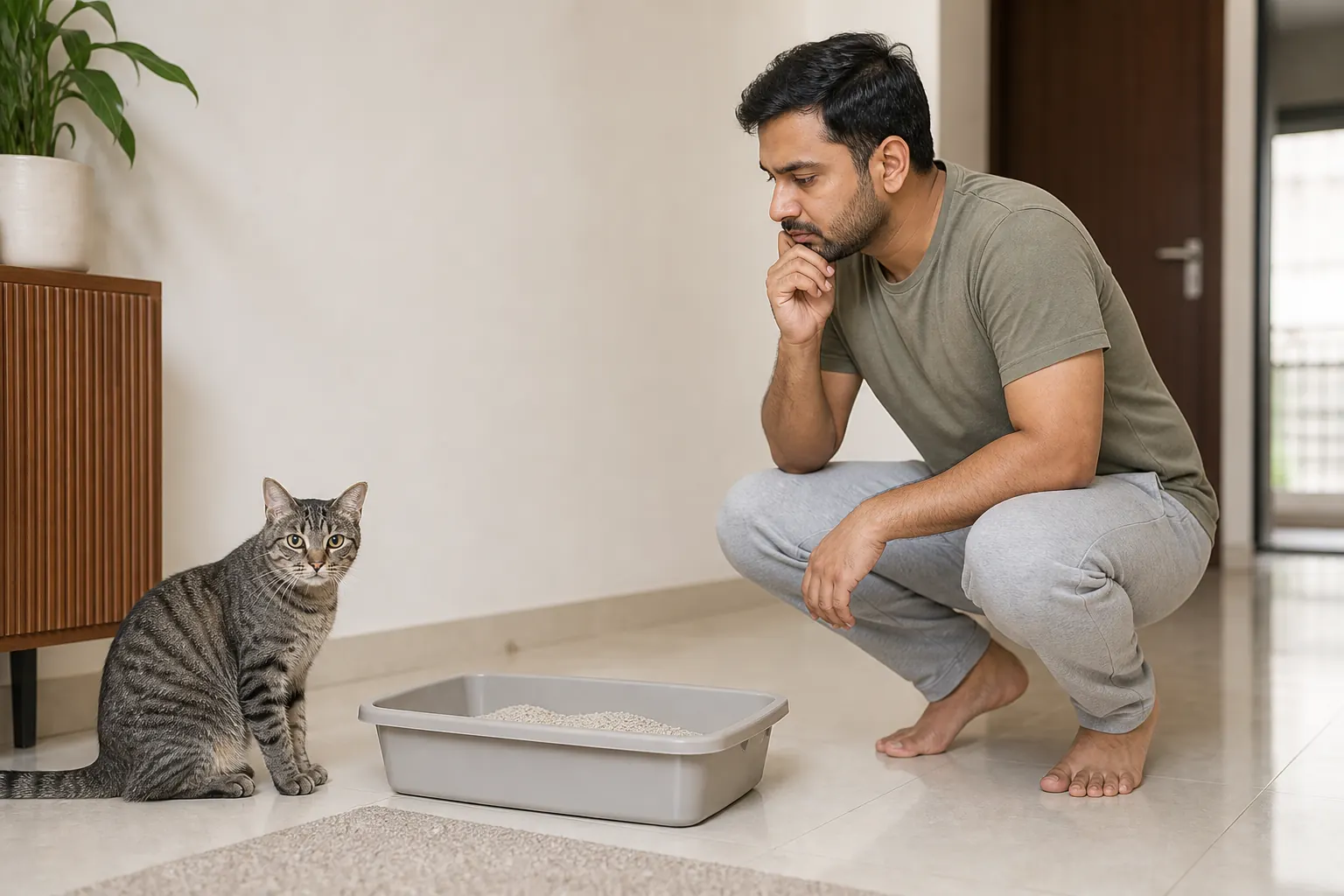
Repeated straining with little or no urine means a physical clinic now
The most important cat urinary blockage symptoms are repeated attempts to urinate with only drops or no urine, frequent return visits to the litter tray, crying or increasing distress, and persistent licking around the genital area. A cat may also pass blood-tinged urine, urinate outside the tray, hide, vomit, stop eating, or become weak and unusually quiet. Do not wait for the later signs.
If your cat is not passing urine, or you cannot confirm a normal amount of urine, call a physical veterinary clinic and leave immediately. This is especially urgent in a male cat, whose narrower urethra makes obstruction more likely. Similar signs can come from several painful urinary conditions, so the safe response is urgent hands-on examination, not a guess about the cause.
Why urine flow can become an emergency
Urine carries waste and excess fluid out of the body. If the urethra narrows or becomes blocked, urine cannot leave. Pressure in the urinary tract rises, which can quickly lead to kidney and/or electrolyte problems, especially in male cats. Use the simplified anatomy below to understand the route urine takes from the bladder through the urethra. Tap each point to explore it.
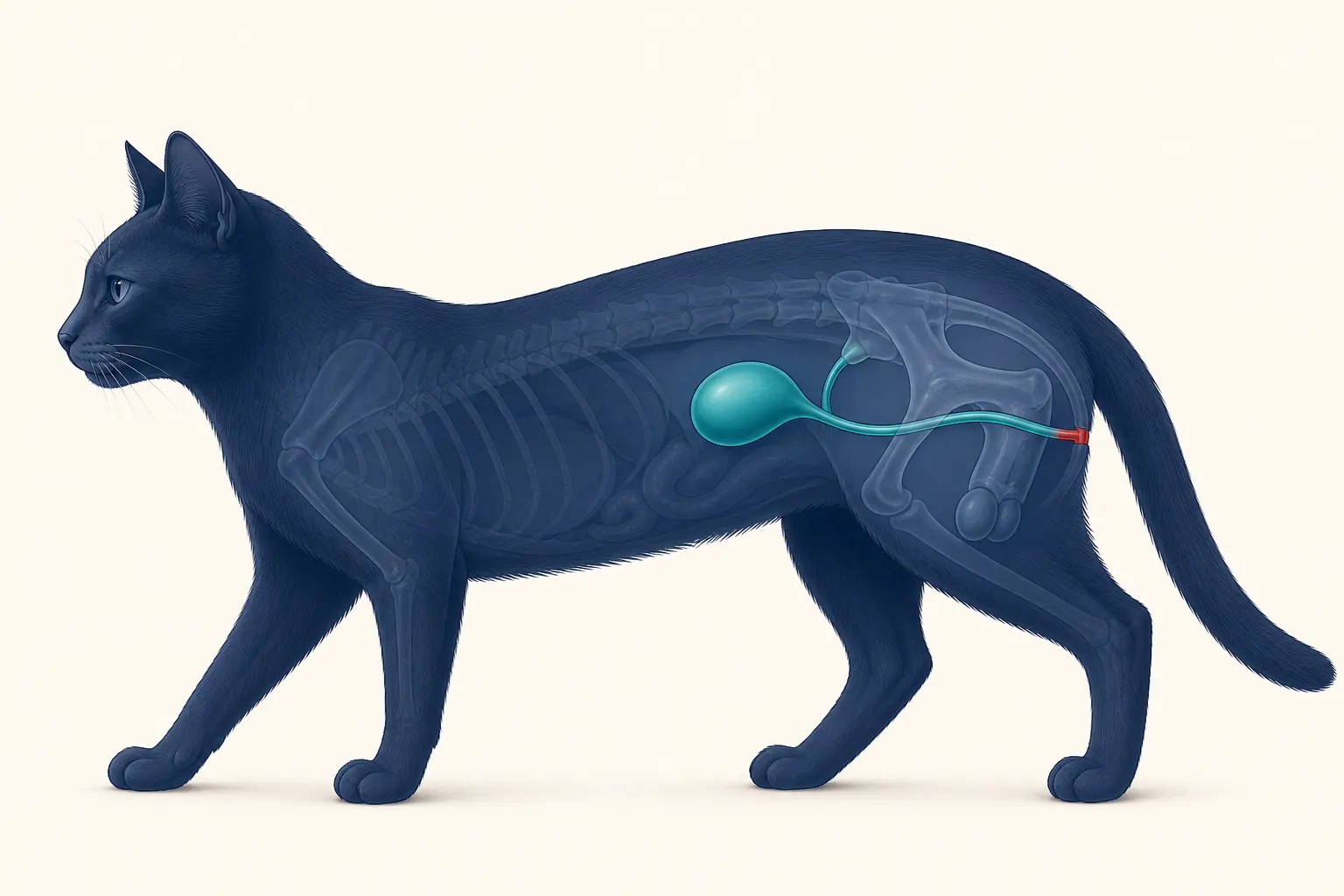
Urine collects here. A veterinarian must assess bladder size, pain, and the cat's overall stability; do not press the abdomen at home.
- Bladder. Urine collects here. A veterinarian must assess bladder size, pain, and the cat's overall stability; do not press the abdomen at home.
- Pelvic urethra. The urethra carries urine out. Inflammation, spasm, plugs, stones, scarring, or other narrowing can impair flow.
- Narrow distal passage. Male cats have a long, narrow outflow path. Obstruction here can stop urine and requires hands-on emergency treatment.
Prepare a clear clinic handoff as you leave
If your cat may be blocked, leave for a physical clinic now. These quick steps help the team prepare, but none should delay travel.
Tell the clinic why you are coming
Say your cat is repeatedly straining and whether you saw a normal amount of urine, only drops, or no urine.
- Tell the clinic why you are coming. Say your cat is repeatedly straining and whether you saw a normal amount of urine, only drops, or no urine.
- Use a secure carrier. Line it with a familiar towel, keep handling calm, and do not press the abdomen or try to empty the bladder.
- Bring the key records. Take current medicine details, recent reports, previous urinary history, diet information, and discharge notes.
- Share what you observed. Tell the team when you last saw a normal urination, tray-visit frequency, appetite, vomiting, energy, and recent household changes. A short video can help only if it does not slow you down.
Cat straining to pee: the litter tray gives clues, not a diagnosis
The concerning pattern is repeated squatting or straining with a small, uncertain, or absent urine output. You may see many tray visits, tiny clumps rather than the cat's usual clump, crying, restlessness, blood-tinged urine, persistent genital-area licking, or urination outside the tray.
Cats use a similar crouched posture to urinate and defecate, so urinary effort can look like constipation. Do not spend time resolving that uncertainty at home. Repeated straining in the litter box without a confirmed normal urine output should be handled as a urinary emergency until a veterinarian examines the cat.
Why male cats are at higher risk of urinary blockage
Feline idiopathic cystitis, urethral plugs, stones, inflammation, urethral spasm, scarring, infection, anatomical abnormalities, and uncommon masses can contribute to urinary signs or obstruction. Male cats have a longer, narrower urethra and are at higher risk of becoming blocked.
Signs, urine colour, or a home video cannot reliably distinguish these causes. Infection is not the default explanation for every cat, and a medicine chosen without examination cannot remove a physical blockage.
- Do not label every urinary sign as a urinary tract infection.
- Do not use a tiny amount of urine as proof that flow is safe.
- Do not treat urination outside the tray as spite, revenge, urine marking or territorial behavior. Pain and urgency can change a cat's toileting behaviour.
- Do not copy another cat's diet or medicine plan.
The clinic must assess stability and restore urine flow
The veterinary team assesses pain, hydration, circulation, overall stability, and the bladder. Blood tests can assess kidney values, electrolytes, and acid–base changes. Urinalysis and imaging such as radiographs or ultrasound may help distinguish stones, inflammation, infection, or another problem. The order depends on the cat's stability.
If the urethra is obstructed, care focuses on stabilisation, pain control, and restoring flow. Relief commonly requires sedation or anaesthesia and a urinary catheter. Intravenous fluids and monitoring may be needed because electrolyte disturbances, kidney injury, post-obstruction urine losses, and re-obstruction can complicate recovery.
Avoid actions that add risk or delay
Do not press or squeeze the abdomen, try to express the bladder, insert anything into the urinary opening, force food or water, wait overnight, or use a home remedy as a test. Do not give paracetamol, ibuprofen, aspirin, another human painkiller, leftover antibiotics, or an old prescription.
Extra water, a warm compress, or a new urinary diet cannot confirm or relieve an obstruction. Hydration, diet, litter-tray setup, weight management, and environmental changes may become parts of an individual prevention plan after the cause has been assessed.
Recovery and recurrence prevention depend on the cause
Use the treating veterinarian's exact diet, medicine, recheck, and monitoring instructions. Depending on the diagnosis, follow-up may include increasing water intake, offering wet food if appropriate, placing clean water sources in quiet locations, keeping litter trays accessible, managing weight, and reducing conflict or unpredictability in the home.
Track urine output, appetite, energy, and the warning signs given at discharge. A shared household log helps prevent repeated visits or declining output from being missed.
Go to a physical veterinary clinic immediately
These patterns can indicate a urinary emergency. Contact a physical veterinary clinic immediately and prepare to leave:
- Repeated straining with no urine, only drops, or output you cannot confirm
- A male cat making frequent, distressed litter-tray visits
- Urinary effort with vomiting, weakness, collapse, or marked lethargy
- A cat that becomes cold, unusually quiet, or less responsive
Call ahead while preparing the carrier. Keep handling calm and do not press the abdomen.
Online when it can be. In person when it must be. Connected throughout.
For a stable cat that is still passing a normal amount of urine, an online consultation can help from the first change—for example, a new litter-tray pattern or unusual urinary behaviour that began today. The veterinarian can clarify what changed, assess urgency from the history and video, and advise whether to monitor, arrange a prompt examination, or seek same-day care. If urine is reduced, absent, or uncertain, treat it as a possible obstruction and go directly to a physical clinic.
How an online vet can help now
- Build a timeline of urine output, tray visits, appetite, pain, and recent changes
- Review photos, videos, and records to identify what needs in-person assessment
- Turn the discussion into a clear monitoring and follow-up plan
- Explain clinic findings and coordinate questions after hands-on care
- Support adherence and continuity between rechecks
When hands-on care is the next step
- Urine output is reduced, absent, or uncertain
- The bladder needs palpation or decompression
- Blood, urine, radiographs, or ultrasound are needed
- A catheter, anaesthesia, injection, or hospital monitoring is needed
- Any emergency or serious systemic sign is present
Frequently asked questions
My cat is straining to pee—are a few drops still an emergency?
Yes. Repeated straining with only drops can occur with partial or complete obstruction and needs an immediate physical examination. A few drops do not prove that the urethra is safely open.
Why is my cat going to the litter box repeatedly?
Frequent visits can reflect lower urinary tract pain, urgency, or impaired flow. Male cats are at higher risk of obstruction, but the cause cannot be identified from visits alone. If output is reduced, absent, or uncertain, go to a physical clinic immediately.
Can a cat urinary blockage clear at home?
Do not wait for that possibility. A suspected obstruction can deteriorate rapidly and requires physical assessment. Home remedies, extra water, massage, or a diet change cannot safely confirm or relieve a blockage.
Could cat straining be constipation instead?
It can be difficult to tell from posture alone. Because urinary obstruction is the more time-critical possibility, repeated straining with uncertain urine output should be handled as a urinary emergency until a veterinarian examines the cat.
What should I bring to the clinic?
Bring the cat in a secure carrier, current medicine details, recent reports, previous urinary history, diet information, and any brief video taken without delaying travel. Report the last normal urine amount if known.
A video consultation can clarify a new, stable change
If your cat is alert, comfortable, and passing a normal amount of urine, book a video consultation when a new tray habit, urinary behaviour change, or post-clinic question needs context. Bring a short timeline, recent reports, medicine details, and any video captured without stressing your cat. Your veterinarian can help you decide what to monitor and what to do next.
Plan a video consultationThis content is for general educational purposes and does not replace a veterinary examination, diagnosis, or treatment. If your pet shows emergency signs or is seriously unwell, contact a physical veterinary clinic immediately.