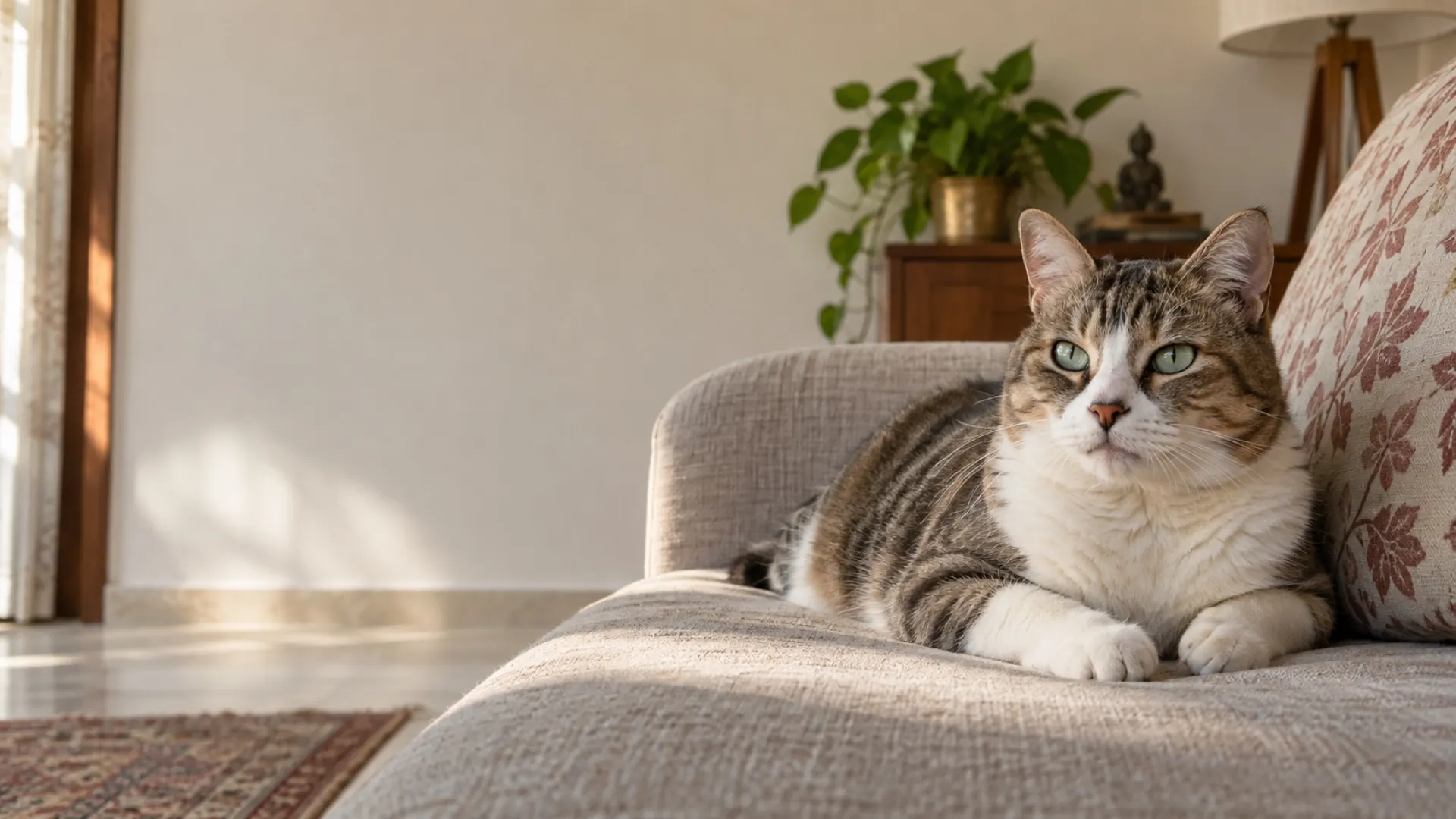
A slow, permanent loss of kidney tissue — not a death sentence
Chronic kidney disease is one of the most common problems of older cats worldwide, India included, and it develops over months to years rather than overnight. Many cats are found while they still look and behave normally, and with the right management they live well for a long time afterwards.
The two changes worth acting on are drinking and urinating more than before, and losing weight quietly over several months. Both are easy to put down to old age. Both deserve a blood and urine test rather than a wait-and-see.
One objection comes up more than any other. The bloodwork was normal last year, so how can the kidneys have failed within a year? They were not normal last year. They were normal-looking. Blood creatinine, the marker almost every Indian laboratory reports, does not move until roughly three-quarters of kidney function is already gone.
The damage cannot be reversed. What treatment does — reliably — is slow the disease and keep a cat comfortable and eating: a therapeutic kidney diet, control of blood phosphorus, treatment of high blood pressure and protein loss, and steady monitoring.
Early signs of kidney disease in cats
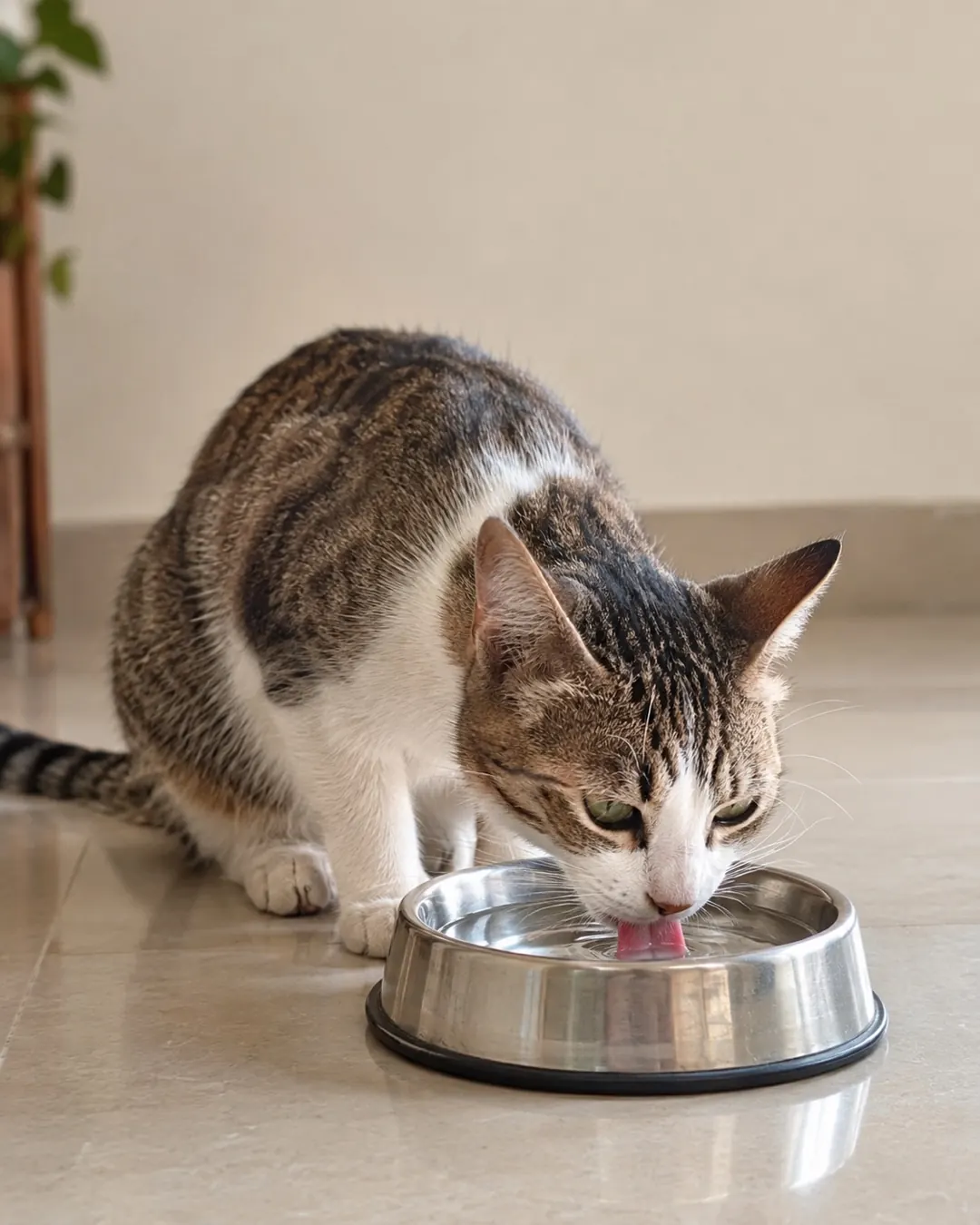
Drinking more, and urinating more. Heavier or more frequent clumps in the litter tray, or a bowl you are refilling more often. This is usually the earliest visible change. It is also the sign most often explained away, blamed on the summer or a warmer flat. Almost nobody knows how much their cat normally drinks, so there is no baseline to compare it against.
Weight loss. Gradual, and easy to miss in a cat you see every day. Running your hands along the spine and hips tells you more than looking does.
Eating less, or turning fussy. Walking up to the bowl, sniffing and walking away is a common pattern. A dull, unkempt coat often appears around the same time, because cats that feel unwell groom less. A cat that stops eating altogether is a separate and more urgent problem.
Lethargy, and later vomiting or bad breath. None of these belongs only to the kidneys — increased thirst points to several conditions, and weight loss in an older cat has a long list of causes. That is precisely why the answer is a test rather than a guess.
One thing worth separating out early. A male cat straining in the litter tray and passing nothing is not this disease. A blocked bladder is a different and immediately life-threatening problem that owners routinely confuse with kidney disease, and hours matter. See the emergency signs below.
What have you noticed at home?
It will help choose the safest next step. Select everything that applies to your cat.
- Nothing selected yet. This check cannot assess your individual cat or diagnose kidney disease. If something has changed at home, a blood and urine test is the way to answer it.
- Keep the monitoring rhythm going. Stage, substage and stability decide how often testing is repeated. Book the review before the due date rather than after a change at home.
- A video consultation is a practical first step. Have any recent blood or urine report ready. A veterinarian can tell you what the values mean, whether the picture fits kidney disease, and exactly which tests to ask for next.
- Speak to a veterinarian today. A cat that stops eating can become seriously unwell within a couple of days. This is not a wait-and-watch situation, whatever the underlying cause turns out to be.
- Contact a physical veterinary clinic immediately. An emergency sign is selected. These need hands-on assessment and stabilisation now; do not wait for an online appointment.
What does the stage on your cat's report mean?
Once kidney disease is confirmed, your vet assigns a stage using the international IRIS system. It is based on fasting blood creatinine, SDMA, or preferably both, measured on at least two occasions in a well-hydrated, stable cat. Select a stage to see what it usually means. One thing the table will not tell you: in practice, cats reach a diagnosis at Stage 3. Stage 1 is close to theoretical. That is an argument for screening, not against it.
Creatinine below 1.6 mg/dl · SDMA below 18 µg/dl
Kidney damage is present but creatinine is still in the normal range, so the diagnosis usually rests on SDMA, dilute urine, protein in the urine, or an abnormality found on imaging. Most cats show no signs at all.
- Stage 1. Creatinine below 1.6 mg/dl · SDMA below 18 µg/dl. Kidney damage is present but creatinine is still in the normal range, so the diagnosis usually rests on SDMA, dilute urine, protein in the urine, or an abnormality found on imaging. Most cats show no signs at all. What usually happens next: Find and treat any underlying cause, check urine protein and blood pressure, and set a monitoring interval.
- Stage 2. Creatinine 1.6-2.8 mg/dl · SDMA 18-25 µg/dl. Mild disease. Many cats still look well, or show only increased thirst. This is where management has the most to offer, because there is still function to protect. What usually happens next: A therapeutic kidney diet, phosphorus control, and treatment of protein loss or high blood pressure if present.
- Stage 3. Creatinine 2.9-5.0 mg/dl · SDMA 26-38 µg/dl. Moderate disease. Signs are usually obvious by now — increased thirst, weight loss, a poor appetite, and often nausea. What usually happens next: Everything above, plus active management of nausea, appetite, potassium and hydration, with closer monitoring.
- Stage 4. Creatinine above 5.0 mg/dl · SDMA above 38 µg/dl. Advanced disease. Cats are visibly unwell and the waste products that make them feel sick are high. What usually happens next: Intensive supportive care and frequent review, with quality of life discussed openly and regularly.
A stage describes kidney function on the day of testing, not a fixed prognosis for your cat. Dehydration can push a reading into a worse stage than the cat truly occupies, which is why staging needs repeat samples from a stable, hydrated cat.
How chronic kidney disease is actually diagnosed
Blood creatinine generally does not rise until roughly 75% of kidney function has been lost, so no single number tells the whole story. A diagnosis is built from a few pieces that have to agree with each other, and from repeat testing rather than from one clever test.
Biochemistry, and SDMA where available
Creatinine, urea, phosphorus, potassium and calcium. SDMA rises at around 40% loss of function, far earlier than creatinine, and is especially useful in thin older cats. It is a good test, and SDMA testing is still limited at most Indian reference laboratories. Ask whether yours runs it. If the answer is no, that is a reason to test serially, never a reason to skip testing.
- Biochemistry, and SDMA where available. Creatinine, urea, phosphorus, potassium and calcium. SDMA rises at around 40% loss of function, far earlier than creatinine, and is especially useful in thin older cats. It is a good test, and SDMA testing is still limited at most Indian reference laboratories. Ask whether yours runs it. If the answer is no, that is a reason to test serially, never a reason to skip testing.
- Concentration and protein. Dilute urine alongside a raised creatinine is the classic picture. The urine protein-to-creatinine ratio matters just as much: below 0.2 is non-proteinuric, 0.2 to 0.4 borderline, above 0.4 proteinuric, and protein loss is treatable. Collect it first thing in the morning where you can. A sample taken mid-afternoon is naturally more dilute, and a thin result from one means much less.
- Blood pressure, where a cat monitor is available. Below 140 mmHg is normal, 140 to 159 pre-hypertensive, 160 to 179 hypertensive, and 180 or above severe. High blood pressure is silent until it damages the eyes, the brain or the kidneys themselves.
- Confirmed over weeks, not in one visit. Chronic means sustained. Two creatinine values six weeks apart, both sitting inside the normal range but moving in the same direction, tell you something neither value tells you alone. Your vet may ask you to repeat a test rather than start treatment on the spot, because dehydration and other short-term factors can raise creatinine on a single day.
Hyperthyroidism can hide kidney disease in cats
This is the part almost no article on the subject covers, and it is why some cats get missed even when somebody did the right tests at the right time. A case from Dr. Vikas Godara's practice in India shows how it works.
Simba was a twelve-year-old domestic shorthair, in for a routine annual exam. He looked well. The only thing his owner mentioned was occasional vomiting, which she put down to hairballs. A senior panel went off to the laboratory: blood count, biochemistry, urinalysis with specific gravity, and a total T4 for the thyroid.
| Test | Simba's result | How it read |
|---|---|---|
| Blood urea (BUN) | 38 | Reference 16 to 36. Borderline high |
| Creatinine | 1.1 mg/dl | Normal |
| Phosphorus | 5.1 | Normal |
| Urine specific gravity | 1.015 | More dilute than expected, but not a first morning sample |
| Total T4 | 3.9 | Borderline band for cats is 2 to 4 |
On paper that is a well cat with one urea value a whisker over the line. Two things did not sit right. The urine was thinner than it should have been, and the thyroid value sat at the top of the borderline band. In his words: “The cat was screaming on that. This is a possible hyperthyroid cat with masked underlying kidney disease.”
The mechanism catches families off guard. An overactive thyroid pushes more blood through the kidneys than they would otherwise handle. That extra flow clears creatinine efficiently and holds the value down. The kidney damage is real and already sitting there. The number is being propped up by the other disease.
A full thyroid panel confirmed hyperthyroidism. Simba started anti-thyroid medication, and his owner was told in advance what would probably happen next.
| Test | Before | After six weeks |
|---|---|---|
| Total T4 | 3.9 | 1.9, normal |
| Blood urea (BUN) | 38 | 45 |
| Creatinine | 1.1 mg/dl | 1.8 |
| Phosphorus | Normal | Normal |
The thyroid was controlled. The kidney disease, no longer masked, surfaced exactly as predicted. Look at what made that diagnosis: neither creatinine value would have raised an eyebrow by itself. It was the movement between them, in a cat being treated for something else, that gave it away.
Simba went onto a renal diet. He is still a patient three years on, still doing well, and he has put on weight, which Dr. Vikas rates as the more meaningful result than any figure on the panel.
Getting a urine sample, and how often to repeat the tests
Urine is the most underrated test in this workup. Concentration and protein, read in series alongside the blood, carry a great deal of information about what the kidneys are actually doing. Most families never hear about the urine sample at all.
First thing in the morning, ideally. There are two ways to get one. You can collect it at home by putting clean, non-absorbent paper cuttings in the litter tray overnight and lifting the sample in the morning. Or you can bring the cat in early and let the clinic take it directly from the bladder with a fine needle, guided by a quick ultrasound. That sounds worse than it is. It takes seconds and gives a clean, uncontaminated sample.
What a dilute result should change. If a proper first morning sample looks suspicious, get a second one the next morning rather than acting on one. And if a sample that was not taken first thing already comes back dilute, that alone is enough to bring the next round of bloodwork forward to about three months, instead of waiting for the annual exam to come round again.
How often to repeat. There is no single interval. It moves with the stage and with how the cat responds. Roughly how Dr. Vikas sets it:
| Where the cat is | When to recheck |
|---|---|
| Just started on diet and conservative management | First recheck at 6 to 8 weeks |
| Values clearly up at that recheck | Again in another 6 to 8 weeks |
| Values steady, not trending up | Push out to around 6 months |
| Early stage and stable | Every 3 to 6 months, sometimes 6 to 9 |
| Advanced disease | Around every 6 weeks |
Blood and urine together each time, not blood alone.
What to feed a cat with kidney disease
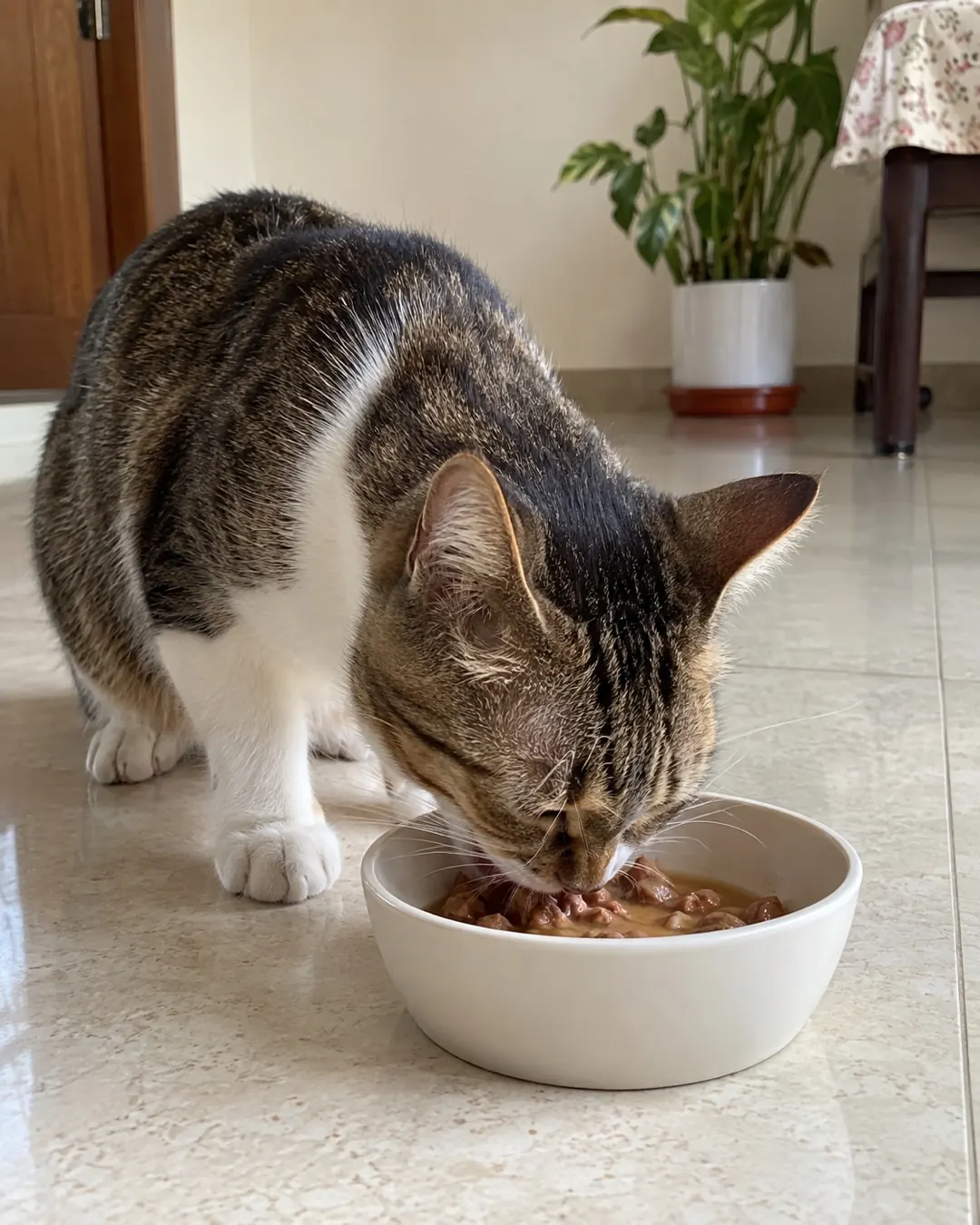
Of everything on this page, diet is the intervention you personally control, and the evidence behind it is the strongest in the subject. Therapeutic kidney diets reduce the signs of uraemia and significantly prolong survival — cats fed one have been reported to live substantially longer than cats kept on ordinary food, which the Cornell Feline Health Center states plainly.
These are veterinary therapeutic diets, not ordinary senior or indoor food. Phosphorus is restricted, because high blood phosphorus drives the disease forward. Protein is moderately reduced rather than slashed, to cut the waste products that make a cat feel sick without starving a thin cat. Potassium is supplemented, because failing kidneys lose it in the urine. Omega-3 fatty acids, B vitamins and buffering against acidity are usually added.
Wet food generally beats dry. These cats struggle to conserve water, so food is a meaningful part of daily intake. Several bowls in different rooms, a wide shallow bowl that does not press on the whiskers, and a fountain if your cat likes moving water all help.
Switch slowly. Over one to two weeks, mix a little of the new food into the old and increase the proportion gradually. Never starve a cat into accepting a new food — cats that stop eating for even a couple of days can become seriously ill. If your cat refuses it outright, or a therapeutic diet is hard to obtain where you live, say so to your veterinarian rather than giving up quietly. There are other ways to reduce phosphorus intake, and a cat eating something is always better than a cat eating nothing.
If the cat is already thin, feeding comes before restricting. Well-meaning families get this backwards. In a cat that is already wasting, or already losing protein in its urine, the priority is not protein restriction. It is calories. As Dr. Vikas puts it, the important thing is that the patient eats first. Once the cat is eating reliably you reduce protein gradually, and a therapeutic renal diet is already formulated low, so the restriction largely takes care of itself.
If you cannot get a therapeutic diet, or your cat refuses it, say so rather than giving up quietly. Therapeutic renal diets for cats are stocked well beyond the metros now, including in tier-two cities, and in Dr. Vikas's experience the food is rarely the limiting factor once you add up everything else a case involves. But a prescription diet is not the only way to start: “Food is the best medicine, and not necessarily you have to always put them on the prescription diet. Maybe you can do some tweaks on the regular diet they are doing.” Which tweaks, and how far they take a particular cat, is a conversation with your vet rather than something to work out from an article.
Home-cooked food sits in the same category, with a clear limit. For a cat in very early Stage 2, adjusting the amount of protein in home food is workable. For advanced kidney disease it is genuinely difficult to put together an adequate home-cooked diet, and it should not be presented to you as an equal alternative.
What treatment involves beyond food
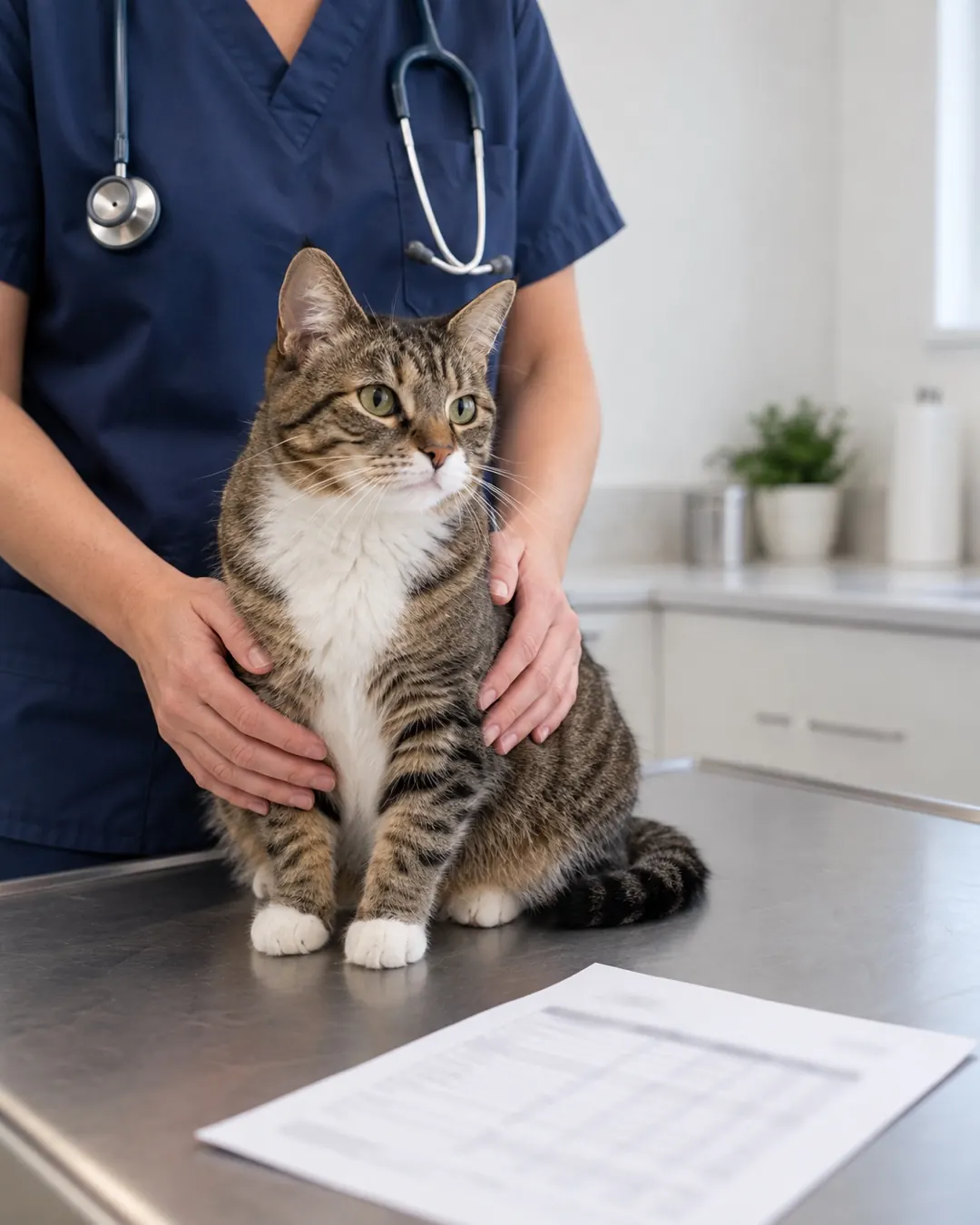
Treatment is built around a handful of aims and adjusted to the individual cat. Your veterinarian may address phosphorus, using diet first and a binder given with meals if diet alone is not enough, which is mixed into the food and more or less tasteless, so cats rarely object to it; high blood pressure, once it is confirmed on more than one reading; protein loss, when the urine ratio stays high or persistently borderline; and potassium, when blood levels fall.
Hydration matters as the disease advances, and some cats need fluids given under the skin at intervals. That is set up, demonstrated and supervised by a veterinarian — it is not something to begin on your own.
What surprises families is how often it ends up being done at home, and the reason is not convenience. The first reason is the cat. Plenty of cats are fractious at the clinic and will never sit for fluid therapy in that setting, for a tangle of reasons. For those cats, home is not the easier option. It is the only route by which the treatment happens at all. The second reason is frequency: a cat brought in for fluids realistically comes twice a week, even in advanced disease, while a family who has been taught can go every other day. The technician demonstrates, you watch it done, and if you are comfortable the kit is dispensed. There is no obligation to take it on.
One exception worth naming. If your cat has a heart murmur or known heart disease, home fluids get riskier, because the volume has to be judged against the whole picture and too much fluid is as dangerous as too little. For those cats it is usually safer to keep fluids in the clinic. Nausea and appetite are treated actively, because a cat that will not eat is an urgent problem rather than a waiting one. Anaemia is treated when it becomes significant.
Drug choices, combinations and doses are decisions for the veterinarian examining your cat, and they change as the disease moves. Never start, stop, skip or adjust a prescribed medicine on your own.
A prescribed anti-inflammatory is a different question from the one in your cabinet. Plenty of older cats need long-term pain relief for arthritis, and current consensus guidance is clear that stable, early kidney disease does not by itself rule it out — meloxicam and robenacoxib both carry good evidence in exactly that group. What kidney disease changes is the supervision: the lowest dose that works, kidney and urine values checked before starting and watched while it continues, and real attention to water intake, because a dehydrated cat is the one these drugs can injure. Tell your veterinarian about everything else your cat takes, since some combinations need closer monitoring. And if your cat goes off its food, vomits, seems dull or unusually thirsty, or you see blood in the vomit or stool, contact the clinic that day rather than waiting.
How long can a cat live with chronic kidney disease?
It depends heavily on the stage at diagnosis, and individual cats vary enormously around any average. Reported median survival in the ISFM consensus guidelines runs roughly like this: Stage 2, about one and a half to three years, with some cats living considerably longer; Stage 3, about five months to a little over two years; Stage 4, typically weeks to a few months.
Read those as broad ranges drawn from groups of cats, not as a prediction for yours. Two things move a cat within its range: whether protein loss and high blood pressure are found and treated, and whether the cat eats a therapeutic diet. Both are reasons to test thoroughly and to persist with the food, and both are within reach.
Numbers only carry so much, though. Set Simba's story beside this one.
Bear was a fourteen-year-old spayed tuxedo cat, seen in Dr. Vikas's practice in the United States. She came in lethargic, vomiting and not eating, with obvious muscle wasting. She had also started urinating outside the tray, and sometimes while asleep. The physical exam found it before the bloods did: her kidneys could be felt through the abdominal wall, irregular in outline, the left one noticeably smaller than the right.
| Test | On arrival | Ten days later |
|---|---|---|
| Blood urea (BUN) | 68 | 73 |
| Creatinine | 6.1 mg/dl | 10 |
| Urine specific gravity | 1.005 | — |
| Urine protein | — | Significant |
Stage 4. An ultrasound to see what state the kidneys were actually in was recommended, and declined. Hospitalisation with fluids to bring the azotaemia down was recommended, and declined too, in the hope it could be handled as an outpatient. Bear went home with an appetite stimulant and an anti-sickness medicine. She was back in ten days, worse on every measure. Her family, facing what came next and what it would cost, chose to let her go.
Two cats, one disease. The difference between them is mostly when it was found, and neither story is unusual or particular to a country. What decided it was whether somebody was watching the trend early enough to act on it.
When the conversation changes to comfort. There is no single number that flips this. It depends on how a cat responds once treatment starts. There is a point, though, where Dr. Vikas starts preparing families in advance: creatinine at roughly three times the upper end of normal, urea at about two and a half to three times. This is also where a piece of language needs correcting, gently. Told their cat is at this stage, many families push hard for aggressive treatment. His answer: “What treatment? This is a management case. This is not a treatment case.” At an advanced stage the goal is comfort and quality of life. That is not the same as giving up. It is choosing the thing that can still be achieved.
The report does most of the work
Whether your cat needs a diet change, whether the stage is real or an artefact of dehydration, whether protein loss is being missed — all of it is settled by the actual values, not by a general article.
If you have a recent report, photograph every page before your next appointment or video call. If the urine result is missing from it, that is worth asking about: the blood tells you how far the disease has gone, and the urine often tells you what can be done about it.
Contact a physical veterinary clinic immediately
Chronic kidney disease is usually slow. These are the situations where the slow rules stop applying.
- Your cat has stopped eating and drinking altogether, is vomiting repeatedly, or has become weak, cold or collapsed
- Sudden loss of sight — bumping into furniture, widely dilated pupils, or bleeding visible in the eye
- Straining in the litter tray, crying, or passing nothing, particularly in a male cat
- Marked weakness with the neck held low and the head drooping
Very high blood pressure can detach the retina, and sight is sometimes saved when it is treated quickly. A blocked bladder is a different and immediately life-threatening problem that is often mistaken for kidney disease, and hours matter. These need hands-on assessment and stabilisation, not an online appointment.
How an online vet can help with your cat's kidney disease
Once the diagnosis exists, most of this disease is managed through interpretation, adjustment and follow-up — which makes it an unusually good fit for a video consultation. It fits for a specific reason. If the thing that actually finds and tracks this disease is a trend rather than a single test, somebody has to be holding the reports together and reading them in sequence. That is the part that most often falls through the gaps between clinic visits.
What a video consultation can do now
- Go through the blood and urine report line by line and explain what each value means for your cat
- Compare the latest report against the last one and tell you which direction things are moving
- Place your cat in an IRIS stage and substage using the numbers already on the report
- Watch your cat eat, drink, walk and hold its head, which is genuinely informative in this disease
- Track body condition and coat across successive calls, so a slow decline becomes visible
- Work through a diet transition that has stalled, and check gum colour for anaemia
- Tell you what the next set of tests should include and when they are due
What still needs the clinic
- Collecting the blood and urine samples themselves
- Measuring blood pressure, and giving fluids or injections
- Ultrasound or any other imaging, and emergency stabilisation
Frequently asked questions
Can chronic kidney disease in cats be cured?
No. The damage is permanent, and no diet, medicine, supplement or herbal preparation regenerates kidney tissue. What treatment does — reliably and measurably — is slow the progression and keep a cat comfortable and eating, often for years. Be sceptical of anything marketed as a kidney cure or detox for cats; the money and, more importantly, the time are better spent on a diagnosis, a diet and regular monitoring.
My cat is being treated for a thyroid problem. Should I be watching the kidneys?
Yes, and your vet should be checking them as a matter of course. An overactive thyroid can hold creatinine down and hide kidney disease that is already present, so kidney values often rise once the thyroid comes under control. That rise is expected. It does not mean the thyroid treatment harmed the kidneys, and it is not a reason to stop it. It means the kidney disease was there all along and is now visible, which is the point at which it can finally be managed.
What are the signs of end-stage kidney failure in cats?
Advanced disease usually shows as persistent refusal of food, ongoing vomiting, noticeable dehydration, marked weakness, hiding, and a cat that has stopped grooming and stopped seeking company. Weight loss becomes obvious rather than subtle, with visible muscle wasting over the spine and hips, and some cats begin urinating outside the tray or in their sleep. There is no checklist that settles the question of when enough is enough, and it is not a decision to make alone from an article — your veterinarian can assess quality of life with you honestly, and that is one of the most useful conversations you will have.
Is kidney disease painful for cats?
Chronic kidney disease itself is not usually thought to be painful the way an injury is, but it does make cats feel unwell — nauseated, weak, and increasingly reluctant to eat. Some underlying causes, such as kidney stones or infection within the kidney, can be genuinely painful. A cat that is hiding, hunched, or reacting when touched should be examined rather than watched.
My cat is drinking a lot but seems completely fine. Should I test?
Yes. A consistent increase in thirst in an older cat is one of the few early warnings this disease gives, and a cat that still looks well is precisely the cat for whom treatment has the most to offer. Increased thirst can also point elsewhere, including to diabetes and thyroid disease, which is another reason to test rather than assume.
Does one raised creatinine reading mean my cat has kidney disease?
Not on its own. Dehydration, a recent meal and other short-term factors can raise creatinine, which is why staging requires values measured on at least two occasions in a hydrated, stable cat, alongside a urine sample. Ask for the test to be repeated before accepting a stage — and equally, do not assume a single normal creatinine has ruled the disease out, since creatinine stays normal until most function is gone.
Can I give my cat fluids under the skin at home?
Some pet parents are taught to, and for the right cat it makes a real difference. It is not a decision to take independently: the need, the volume and the frequency are judged by a veterinarian, and the technique has to be demonstrated properly. Too much fluid is as much a problem as too little, particularly in a cat with heart disease.
Have the report read line by line
Bring a recent blood and urine report for your older cat to a video consultation, and leave knowing the stage, what it means, and which test comes next.
Talk to a Vetezy vet
A practising veterinarian who has worked in small animal practice in India and in the United States. He reviewed this article for clinical accuracy, and the case records, monitoring intervals and practice guidance in it are drawn from his own work.
The veterinarian behind VetezyThis content is for general educational purposes and does not replace a veterinary examination, diagnosis, or treatment. If your pet shows emergency signs or is seriously unwell, contact a physical veterinary clinic immediately.
Clinical references
- International Renal Interest Society (IRIS) — IRIS Staging of Chronic Kidney Disease
- ISFM Consensus Guidelines on the Diagnosis and Management of Feline Chronic Kidney Disease, Journal of Feline Medicine and Surgery
- Cornell Feline Health Center — Chronic Kidney Disease
- International Cat Care — Chronic kidney disease (CKD) in cats
- IRIS staging thresholds in full
- Today's Veterinary Practice — Feline Chronic Kidney Disease