Rabies in dogs and cats, in four sentences
The first symptom of rabies in dogs and cats is usually a sudden change in behaviour: hiding, restlessness, or an unusually quiet or clingy animal. Within days this becomes either aggression and biting (furious rabies) or a dropped jaw, drooling and weak back legs (paralytic rabies). Death follows within about 3–8 days of the first symptoms, and there is no treatment once they start.
If an animal's bite or scratch breaks your skin, wash the wound with soap and water for at least 15 minutes and get the free anti-rabies vaccine at a government hospital the same day. A lick on unbroken skin, or stroking a street dog, needs nothing at all.
Dr. Vikas Godara, the veterinarian who reviewed this guide, recommends making this your knee-jerk reflex after a bite or possible exposure to a rabid animal: “wash the wound thoroughly with soap and water, and then seek immediate medical help”. He has more than 11 years of small-animal practice in India and the United States.
Bitten or scratched right now? Do this first
Bitten, or scratched through the skin, by a dog, cat or monkey?
- Wash the wound with soap under running water for at least 15 minutes, ideally 20. Any soap works; bathing soap and detergent are both fine. If you have an antiseptic, put it on afterwards.
- Put nothing else on it. No chilli, mustard oil, turmeric, lime or salt. Don't get it stitched or bandaged unless the doctor decides to.
- Get the free vaccine today at any government hospital or anti-rabies clinic. Don't wait to see what happens to the animal.
- Call the national rabies helpline, 15400 (toll-free) for first-aid advice and the nearest centre with the vaccine in stock. It currently covers five states and union territories: Delhi, Assam, Andhra Pradesh, Madhya Pradesh and Puducherry. Elsewhere, go straight to the hospital.
- Finish the course. Every dose on the card, on the day it's due.
Rabies symptoms in dogs and cats
Rabies is rare in a pet that gets its yearly shot. Take it seriously in an unvaccinated or overdue animal, especially one that's been in a fight or bitten recently, and in any street animal behaving strangely. Here's how the Indian government's action plan, NAPRE, describes the disease.
Early signs of rabies in dogs and puppies
The dog behaves oddly, hides in dark corners, and becomes restless or unusually agitated. There may be fever, wide pupils and discomfort in bright light. Puppies show the same change, and it's easy to misread: a young pup that is crying, can't get up or keeps snapping is usually assumed to be hurt, as the case below shows.
Furious rabies in dogs
The dog bites without provocation, sometimes even biting itself. It may eat things that aren't food, roam, and snap at nothing. Its bark changes as the vocal cords become partly paralysed.
Paralytic (“dumb”) rabies in dogs
Some dogs skip the furious stage entirely. They show a dropped jaw, drool and froth because they can't swallow, and wobble on weak back legs. Convulsions, collapse and death follow, generally within 3–8 days of the first symptoms.
Rabies symptoms in cats
In cats, rabies is usually the furious type. Cats hide in secluded places and turn more vicious than dogs. A rabid cat may strike at the air with its front paws as if catching imaginary mice. After 2–4 days of this, the back half of the body becomes paralysed.
Rabies incubation period in dogs, cats and people
| Incubation in dogs (bite to first symptoms) | 3–8 weeks on average; from 10 days up to 6 months, rarely more than 4 months |
|---|---|
| Symptoms to death in a dog | Generally 3–8 days |
| Incubation in people | 3 weeks to 3 months, rarely from 4 days up to 2 years |
| When a dog or cat becomes infectious | A few days before symptoms (hence the 10-day rule) |
| Once symptoms appear, in animals or people | Fatal |
| Your window to act | Before the virus reaches the nerves. In practice, the same day |
What rabies looked like in a real puppy: a case from Panchkula
Textbook lists are one thing. Here's what walked, or rather didn't walk, into Dr. Vikas's clinic.
| Where | Pet Panacea, Dr. Vikas's practice in Sector 21, Panchkula, 2021 |
|---|---|
| The patient | A puppy of about five or six months, brought in by a rescuer |
| How it looked | Lying down and unable to get up. “Supremely lethargic”, yet still trying to bite things |
| The voice | “Completely changed… all the grunting noise, but no bark” |
| The mouth | Drooling saliva, and a visibly paralysed lower jaw |
| The decision | “We were highly suspicious of rabies.” With the rescuer's consent, the puppy was put to sleep |
| The proof | The head went through a microbiology researcher at GADVASU, Ludhiana, to a rabies diagnostic laboratory in Kasauli, Himachal Pradesh. A fluorescent antibody test confirmed it: “100% confirmatory diagnosis of rabies” |
| The people | Dr. Vikas and his whole team were already vaccinated against rabies as a precaution. He asked the rescuers to get the post-exposure vaccine “even if in doubt” |
Put that puppy next to the government's description of paralytic rabies and it matches almost line by line: the dropped jaw, the drooling, the changed voice, the collapse. It's also why the warning in the next section matters.
If you think a dog or cat has rabies
If you suspect rabies in your own pet, keep people and other pets away from it and don't try to treat it at home. Call a vet or your municipal veterinary office before moving it. Anyone it has bitten or scratched, or licked on broken skin, follows the dog bite steps below the same day.
Is there any treatment for rabies in dogs?
No. Once symptoms start, rabies can't be treated in dogs, cats or people. What does work is prevention: the yearly vaccine, and a booster straight away if your pet is bitten. Both are covered in our rabies vaccine guide for dogs and cats.
Is there a rabies test for dogs?
Not in a living animal. Rabies is confirmed on brain tissue after death, as it was for the Panchkula puppy. That's why observation, vaccination records and the 10-day rule do so much of the work.
Found an injured street puppy? Pause before you pick it up
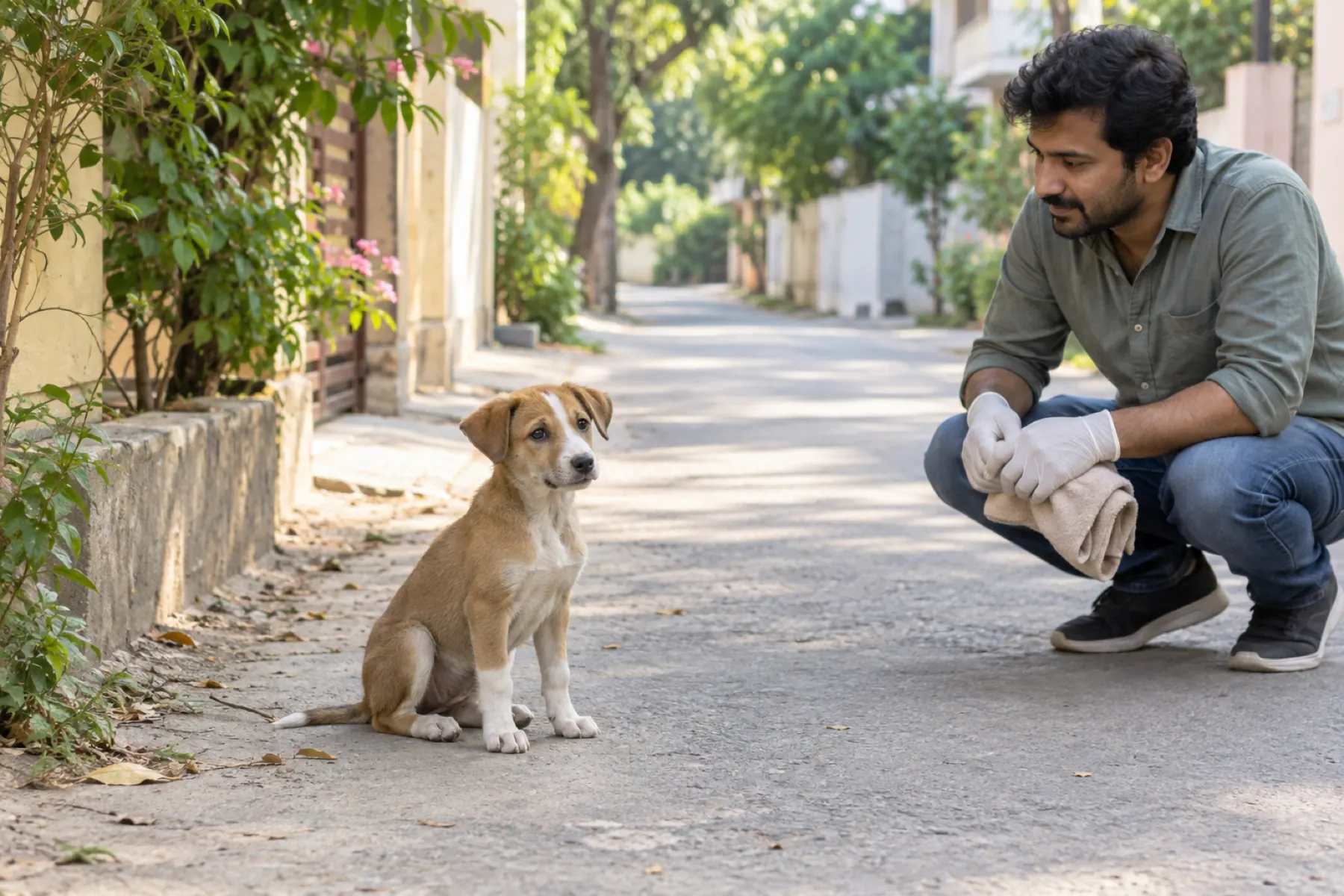
A puppy is crying at the side of the road. Maybe a bike clipped it; maybe it's just yelping and can't get up. Everything in you says pick it up.
Dr. Vikas says that moment is where he'd want every Indian pet parent, feeder and rescuer to pause. “The first instinct is to go pick that puppy, and that's what I think is the highest risk, because a young puppy can also be rabid.”
His reasoning is about how people read danger. “An adult dog with rabies symptoms, everyone would be worried about it, ‘the dog might bite, the dog might bite’, so they would be a bit cautious. But the false sense of security in cases of small dogs or puppies is what I would want the pet parents to know. Those are probably the highest risk, especially street dogs crying or yelping.”
The puppy in his case was found by a rescuer, and it was rabid. This isn't hypothetical. So how do you help safely? These are Vetezy's practical steps, in the spirit of what Dr. Vikas asks:
- Don't scoop it up with bare hands. Use a thick towel, a jacket or gloves, and keep your hands away from its mouth, however small it is.
- Don't hand-feed it, and don't let it lick your cuts. Put water down; don't hold it to the puppy's mouth.
- Call for help before you handle it: a local rescue group, an animal welfare organisation or your municipal veterinary office.
- If it bites or scratches through your skin, or licks a cut, follow the dog bite steps the same day. A small bite still counts.
- Tell the vet everything about how the puppy was acting: unable to stand, a dropped jaw, drooling, a strange voice. Those details matter.
If you feed or rescue street animals regularly, talk to your doctor about pre-exposure rabies vaccination. The national guideline recommends it for animal handlers, and if you're ever bitten afterwards, you need far fewer doses and no immunoglobulin. It's what Dr. Vikas does for his own clinic team, himself included.
Dog lick, scratch or bite: when you don't need a rabies injection
“Panic about something that is harmless.” That's the rabies mistake Dr. Vikas sees most often, ahead of anything dangerous. “Mostly it's a scratch from the doggy nail, even on their fully vaccinated dog, or a play nip that didn't get through the skin.”
His dividing line is simple, and it matches the government's: “It is actually skin broken versus the skin not broken.”
Rabies spreads when saliva gets into the body, through a bite, a scratch, broken skin, or the eyes, nose or mouth. The virus can't get through intact skin. Under India's national rabies guideline, these need no rabies injection:
- Touching, stroking or feeding a dog or cat, including a street dog.
- A lick on unbroken skin.
- Touching an animal's blood, urine or faeces. None of these carries rabies.
- Bites from rats, mice, squirrels or rabbits. The guideline says these don't ordinarily need rabies treatment. See a doctor for the wound itself, since bites get infected.
The bigger picture is better than the headlines too. ICMR's national survey estimated about 5,700 human rabies deaths a year in 2022–23, against about 20,500 in a 2003 national survey: nearly three-quarters fewer in 20 years. The vaccine works if you start it on time and finish it.
Can a dog lick cause rabies?
Only if the saliva reaches broken skin or the inside of your body. Your dog licking your face or hands is Category I: no injection, as long as there's no cut, graze or open wound there. A lick on a cut, a graze or a healing wound, or in your eyes, nose or mouth, is Category III. Wash it and go to the hospital today.
Dog scratch with no blood: do you need the injection?
It depends on one thing: did the skin break?
Look closely under good light. A white line or a red mark on intact skin, where nothing has opened, is not an exposure. If the skin is broken, even as a thin graze without bleeding, that's Category II under the guideline: wash the wound thoroughly for at least 15 minutes and start the vaccine. A scratch that breaks through the skin is Category III, which adds rabies immunoglobulin. Don't overlook scratches: a scratch that breaks the skin can be a rabies exposure, even without a bite.
Can a cat scratch or cat bite cause rabies?
Yes. Cats cause about 2% of human rabies in India, and the rules are the same as for dogs. A cat bite that breaks the skin is Category III. Cat bites are deep punctures that get infected easily, so they need a doctor even when rabies isn't the concern.
Is a puppy bite dangerous?
It can be. A puppy's age doesn't protect you, and a puppy from an unknown or unvaccinated mother can carry rabies. The only confirmed rabies case Dr. Vikas describes above was a puppy of five or six months. Treat a bite that breaks the skin like any other dog bite. If it's your puppy, or one you can watch for 10 days, that helps your doctor decide how much treatment you need.
When to act, calmly, today
- Any bite or scratch that breaks the skin, even a small one, even from your own pet.
- A lick on a cut, a wound or broken skin, or saliva in your eyes, nose or mouth.
- A nibble on bare skin that left a mark through it.
- Any bite from a monkey or a wild animal.
“Today” means today, but it doesn't mean panic. You have time to wash the wound properly and get to the hospital.
Bitten or scratched by your own vaccinated dog?
A play nip, a paw that caught your arm on a walk, a grab at feeding time. When the dog is your own, fully vaccinated and perfectly well, Dr. Vikas does four things.
- He always sends the person to “their healthcare professional, the medical doctor”, because the human side is the doctor's decision.
- He checks the dog's vaccination certificate to make sure the boosters were on time.
- He asks the family to watch the dog for 10 days: “Yes, 100%.”
- And he tells them, “just to ease their mind”, that “the probability of exposure to rabies is negligible, provided that their dog is acting normal, healthy, no other symptoms.”
Hold both of those at once: see the doctor, and don't lose sleep.
If the skin didn't break
There's no exposure. A nail mark or a play nip that didn't open the skin needs nothing beyond washing it.
If the skin broke
Wash it for at least 15 minutes and see a doctor the same day, taking the dog's certificate (a photo is fine). The doctor will usually start the vaccine. If your dog is well on day 10, the doctor may shorten the course, and with a proper certificate they may even defer it. That's their decision to make, not yours.
Can a vaccinated dog get rabies?
It's rare, but yes. Animal vaccinations can fail if the vaccine was stored badly, a booster was missed, or the dog was sick when vaccinated. That's why the certificate matters, why the doctor still decides, and why a vaccinated pet bitten by a street dog still gets a booster (see what to do if a street dog bites your pet).
Dog bite: what to do, step by step
People get this wrong in both directions. Some rush in for a full course of injections because a dog licked their arm. Others skip treatment because “it's our own dog” or “it's only a scratch”.
The Indian guideline has one clear order: treat the wound and start the vaccine first, then use what you learn about the animal to adjust. Whether the dog was a stray or a pet, vaccinated or not, healthy or sick, all of it matters. It matters after you've started, never as a reason to wait.
Step 1: पहले साबुन. Wash the wound, whatever happened
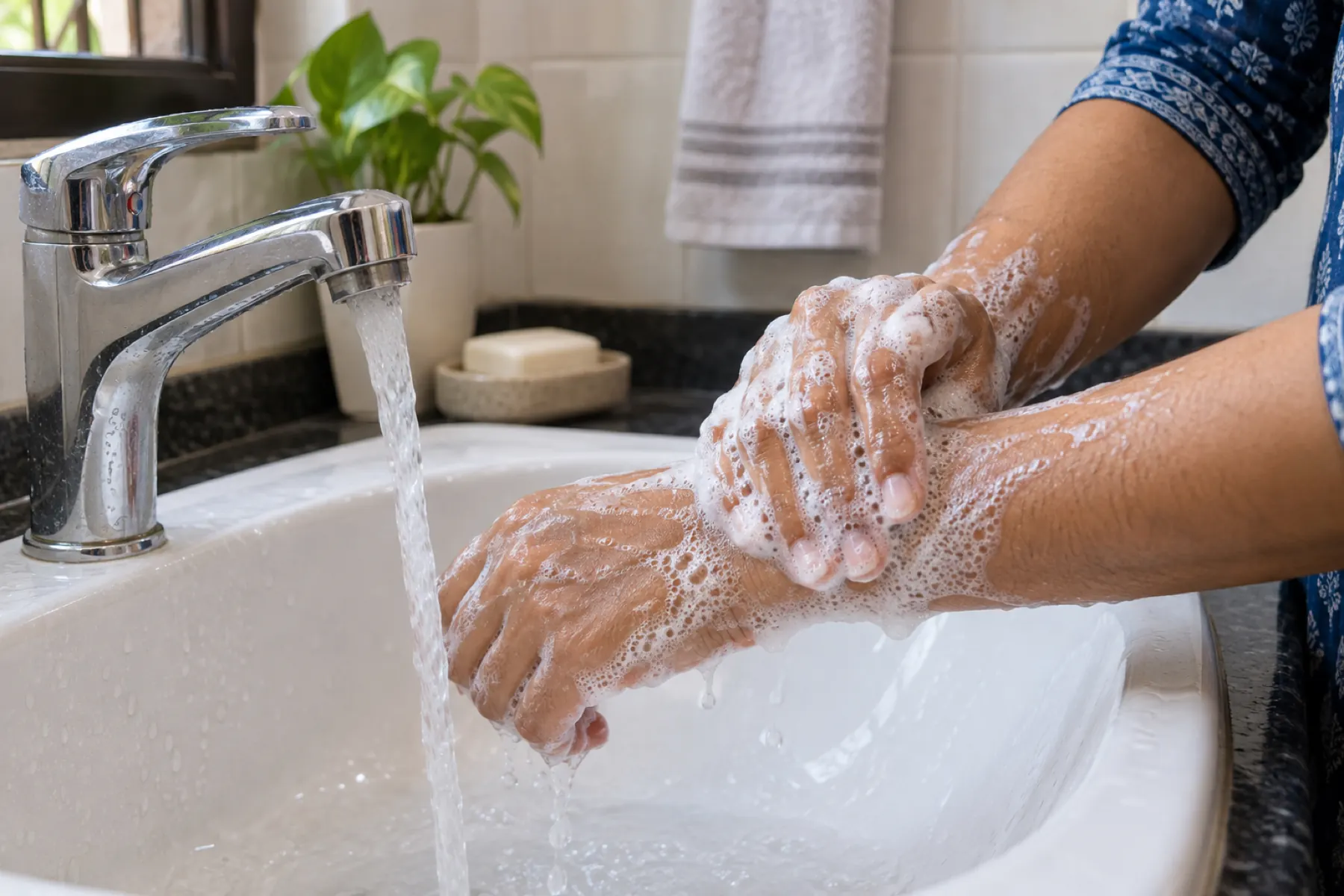
At least 15 minutes, ideally 20, with soap, under running water. You don't need to know anything about the animal to do this, and it can't hurt.
It's also the step people skip. In ICMR's survey, only 54% of dog-bite victims washed the wound with soap and water. Dr. Vikas calls it the thing he most wishes everyone understood, “in a manner that they never forget”. Fifteen minutes is longer than it sounds.
Step 2: Which dog bite category is it: I, II or III?
India's guideline sorts every contact into three categories:
| Category | What happened | What you need |
|---|---|---|
| I | Touching or feeding the animal. A lick on unbroken skin | Nothing |
| II | A nibble on bare skin. A minor scratch or graze that broke the skin without bleeding | Wound washing + vaccine |
| III | A bite or scratch that breaks the skin and bleeds, even one. A lick on broken skin. Saliva in the eyes, nose or mouth | Wound washing + vaccine + rabies immunoglobulin |
If you can't tell which category it was, the guideline says to treat it as the higher one and let the doctor at the anti-rabies clinic decide. That isn't overcaution. The doctor sees these every day and can judge the wound in seconds.
Step 3: Which animal was it?
- Dog or cat: go to Step 4. These are the only animals where watching the animal for 10 days can change your treatment.
- Monkey, or a wild animal (jackal, mongoose, fox): always Category III, and watching the animal doesn't count.
- Rats, mice, squirrels, rabbits: no rabies treatment needed ordinarily. Get the wound looked at.
Step 4: Can the dog or cat be watched for 10 days?
This is where “stray or pet?” comes in. It can change your treatment. It just doesn't change the first dose.
- Your own pet, a neighbour's pet, or a street dog you see every day: start the vaccine anyway, then keep an eye on the animal. If it's alive and well on day 10, tell your doctor, who can then shorten or adjust your course.
- A stray you'll never find again: full course.
- The animal falls ill, acts strangely, disappears or dies within those 10 days: full course, and tell the doctor straight away.
Why 10 days? A dog or cat only has the virus in its saliva near the end of the disease, a few days before symptoms show. If it was infectious when it bit you, it would be visibly sick or dead within 10 days. A healthy dog on day 10 couldn't have passed on rabies that day.
Step 5: Was the animal vaccinated?
This counts for less than people think. The guideline is direct about it: a vaccinated dog or cat is less likely to have rabies, but animal vaccinations can fail because of a badly stored vaccine, a missed booster or a sick animal. A neighbour saying “he's vaccinated” isn't evidence.
What counts is proper documentation: a signed certificate with dates, showing boosters given on time. That's the first thing Dr. Vikas checks, and it's the only thing that lets a doctor consider deferring your treatment. The decision stays with the doctor. It's also why your own pet's rabies vaccination certificate matters.
Step 6: Have you been vaccinated against rabies before?
If you've had a full course before, after an earlier bite or as a precaution, and you have the record, tell the doctor. You'll usually need far fewer injections and no immunoglobulin. Keep your own vaccine card as carefully as your pet's.
Step 7: Finish the course
In ICMR's survey, nearly half of those who started the vaccine didn't finish it, and only about 4 in 10 dog-bite victims completed the course. The course is timed around your immune system, not your wound. A healed wound doesn't mean you're protected.
What happens at the hospital
- The doctor picks the schedule and gives you the dates. Today's vaccine is a short course of injections in the upper arm over about four weeks. Your job is to turn up on every date.
- Day 0 is the day of your first injection, not the day of the bite. Bitten on Monday, first dose on Wednesday? Wednesday is day 0.
- For a Category III exposure, the doctor also gives rabies immunoglobulin into and around the wound, usually with the first dose.
- If a dose gets delayed, go as soon as you can and ask the doctor how to continue. Don't restart on your own, and don't abandon the course.
The government's National Rabies Control Programme site has a calculator that works out your dose dates from day 0.
Free rabies help in India
- The vaccine and immunoglobulin are free at government hospitals under the National Health Mission's free drugs initiative. Private hospitals charge per dose.
- Helpline 15400. Toll-free, 16 hours a day, 7 days a week, in Hindi and English. It gives first-aid advice and tells you which nearby facilities have the vaccine and immunoglobulin in stock. So far it covers five states and union territories: Delhi, Assam, Andhra Pradesh, Madhya Pradesh and Puducherry.
- rabiesfreeindia.mohfw.gov.in, the national rabies website, has a facility locator and a calculator for your vaccine dates.
The free vaccine should be in stock at your nearest government hospital. If it isn't, 15400 (where it's live) or the rabies website can point you to the nearest place that has it.
Common rabies mistakes, and what to tell the doctor
The mistakes that matter most
The first two are the ones Dr. Vikas sees most in his practice. The rest come straight from India's national guideline.
- Panicking over harmless contact. A lick on unbroken skin, or a nail mark where the skin didn't open, needs nothing.
- Letting your pet's yearly booster lapse. “Not all pet parents, some of the pet parents,” he says. A lapsed pet bitten by a street dog needs a full course, not one booster. Check the date with our booster-date checker.
- Rushing the wash. Fifteen minutes of soap and running water is the single most protective thing you can do, and the step people skip.
- Waiting to see if the dog gets sick. Start the vaccine the same day. The 10 days only let the doctor adjust the course later.
- Putting chilli, oil, turmeric, lime or salt on the wound. The guideline calls these “unnecessary and damaging”.
- Stopping when the wound heals. The course is timed around your immune system, not the wound.
- Picking up an injured street puppy with bare hands. Dr. Vikas's highest-risk moment.
- Putting a hand in the mouth of a dog that seems to be choking. A rabid dog that can't swallow looks exactly like one with a bone stuck.
What to tell the doctor at the anti-rabies clinic
- Which animal it was: your pet, a street dog you know, or a stray you'll never see again.
- Where on your body, and whether the skin broke or bled.
- When it happened, and whether you washed it and for how long.
- Anything that was put on the wound at home.
- The animal's rabies certificate, if it's a pet. A photo is fine.
- Your own rabies vaccination record, if you've ever had the vaccine.
- Whether the animal can be watched for the next 10 days.
What to tell your vet if your pet was the one bitten
- Your pet's last rabies vaccination date, with the certificate in front of you.
- When and where the bite happened, and where on your pet's body.
- What the other animal was like, and whether it's a known local dog.
- Any change in your pet since: eating, walking, voice or behaviour.
What the vet does next depends on that vaccination date. Dr. Vikas's protocol is in our rabies vaccine guide.
Rabies myths in India: stomach injections, food rules and home remedies
Rabies attracts more folk advice than almost any other disease in India. Some of it is harmless. Some of it costs people the days that matter.
“You need 14 injections in the stomach”
That was the old nerve-tissue vaccine, and India stopped producing it in 2004. Today's vaccine is a short course in the upper arm. If fear of stomach injections is keeping someone in your family from the hospital, show them this.
“Don't eat certain foods after a dog bite”
India's national rabies guideline lists what to do after a bite: wash the wound, don't apply irritants, get the vaccine, finish the course. It sets no food restrictions. Eat normally. What matters is the vaccine schedule, not what's on your plate.
Home remedies: chilli, oil, turmeric, lime, salt
The guideline calls these “unnecessary and damaging”. They irritate the wound and do nothing against the virus. If someone has already put them on, wash them off gently with soap and plenty of water, then carry on with the steps above. No gharelu upay replaces soap, water and the vaccine.
“You can get rabies from cow milk or meat”
According to the government's rabies action plan, catching rabies from the milk or meat of an infected animal is theoretically possible but has never been confirmed. Boiled milk from your usual supplier isn't a rabies risk.
“Rabid dogs are afraid of water”
Fear of water is a symptom in people, where swallowing becomes painful and triggers spasms. A rabid dog doesn't fear water. It just can't swallow it.
“No foaming, no rabies”
Many rabid animals never foam. Plenty of foaming animals don't have rabies: heatstroke, bitter-tasting medicine or licking a toad can all cause it.
How rabies spreads: from a bite to the brain
Knowing what the virus is actually doing takes a lot of the fear out of it. It also explains why the steps above work.
Where the virus lives
Rabies is a virus of the nervous system. In a rabid animal it sits in the brain, the nerves and the saliva. That's why saliva is the only thing the bite categories care about.
How long can the rabies virus survive outside the body?
Not long. The virus breaks down when it dries out and in heat and sunlight, and soap and disinfectants inactivate it. That's why the washing works: 15 to 20 minutes under the tap physically removes the virus and kills much of what's left. The government guideline treats that washing as just as important as the vaccine.
The wait at the wound
This part is good news, and most people have never heard it. After a bite, the virus doesn't go straight to the brain. It can stay in the muscle and tissue around the wound, multiplying, for days or weeks before it gets into a nerve. That delay is your window: while the virus is still at the wound, the vaccine and immunoglobulin can reach it. That's why the guideline says to wash a wound even if you arrive late, and to treat people who turn up weeks or months after a bite.
Why bites near the head are the most urgent
Once it's in a nerve, the virus travels slowly along it to the spinal cord and then the brain. Bites to the face, head, neck and hands are close to the brain and packed with nerves, so they're treated most urgently. Whatever the bite, the answer to “how much time do I have?” never changes: start today, and you're well inside the window.
Brain first, then saliva
When the virus reaches the brain, it spreads outwards again, to the salivary glands. Only then can the animal pass rabies on, and that's only a few days before symptoms appear. It's the basis of the 10-day rule in Step 4.
What an online vet can and can't do about rabies
A video appointment can't give a vaccine, and it can't examine an animal you think has rabies. Don't bring a suspected rabid pet near anyone. Call a clinic or your municipal veterinary office instead.
Where a video appointment helps
- A scratch or play-nip from your own pet: the vet checks the certificate and the booster dates with you, and helps you decide what to tell your doctor. That's the conversation Dr. Vikas has most often.
- After a street dog or cat fight: the vet looks at your pet's wound on camera, checks the vaccination date with you, and tells you whether it needs a clinic tonight or tomorrow.
What needs a clinic or hospital
- Any vaccine, for you or your pet
- An animal you think has rabies
- A deep or bleeding wound
- A person who has been bitten: that's a doctor, today
Frequently asked questions
Is rabies curable?
Not once symptoms appear, in animals or people. Before that, washing the wound, the vaccine and, for deep bites, immunoglobulin prevent it almost completely.
How soon do rabies symptoms show in a dog after it is bitten?
Usually 3 to 8 weeks after the bite, though it can be as short as 10 days or as long as 6 months. In people it is usually 3 weeks to 3 months. That is why you start the vaccine the same day instead of waiting for signs.
How long after a dog bite can I still take the injection?
The same day is best. But the Indian guideline says people who come in late, even months later, should still be assessed and treated. Late is much better than never.
Should I wait 10 days to see if the dog gets sick before getting vaccinated?
No. Start the vaccine the same day. The 10 days only let the doctor adjust the course later.
I feed street dogs every day. Should I get the rabies vaccine?
Talk to your doctor about pre-exposure vaccination. India's guideline recommends it for animal handlers. If you are bitten afterwards, you need far fewer doses and no immunoglobulin.
How long does the rabies vaccine last in humans?
After a full course, your immune system remembers it for years. If you are bitten again, show the doctor your record: you will need far fewer doses and no immunoglobulin.
Can rabies spread from one person to another?
According to the government's action plan, it is theoretically possible through a bite or saliva but has never been confirmed. Looking after a family member who is having the vaccine carries no risk: the vaccine cannot give anyone rabies.
Does my dog or cat need the rabies vaccine every year?
Yes. In India the government's advice is every pet, every year, starting at about three months old. The full schedule, the price and a booster-date checker are in our rabies vaccine guide.
Check the certificate with a vet
Have the vaccination card ready. A vet can check the booster dates with you and help you decide what to tell your doctor, and whether your pet needs anything itself. Keep the full puppy and kitten plan handy too: the puppy vaccination schedule and the cat vaccination guide.
Talk to an expert
VCI Reg. No. 7503 · HVC Reg. No. 2649 · Member, AVMA (#323100) & CVMA (#49706) · USDA-accredited veterinarian · 11+ years in small animal medicine and surgery.
The rabies case, quotes and practice advice in this article come from his own practice in India. No owner or rescuer is identified.
Dr. Vikas Godara's profile The veterinarian behind VetezyThis content is for general educational purposes and does not replace a veterinary examination, diagnosis or treatment, or medical advice for people. If you have been bitten or scratched, see a doctor at a government hospital or anti-rabies clinic today. If your pet shows symptoms of rabies or is seriously unwell, contact a physical veterinary clinic immediately.
Sources
- National Centre for Disease Control. National Guidelines for Rabies Prophylaxis, 2019. Exposure categories, wound care, the 10-day observation, vaccination status of the biting animal, re-exposure, pre-exposure vaccination for animal handlers, nerve-tissue vaccine discontinued in 2004.
- MoHFW and MoFAHD. National Action Plan for Dog-Mediated Rabies Elimination from India by 2030 (NAPRE). Transmission, incubation, symptoms in dogs and cats.
- National Rabies Control Programme: rabiesfreeindia.mohfw.gov.in. Helpline 15400, facility locator, dose calculator.
- Department of Animal Husbandry and Dairying. Lok Sabha Unstarred Question No. 4870, answered 1 April 2025. Free anti-rabies vaccine and immunoglobulin at government facilities.
- ICMR-NIE et al. Estimates of the burden of human rabies deaths and animal bites in India, 2022–23. The Lancet Infectious Diseases, 2025;25(1):126–134; survey findings as reported by ThePrint.
- Sudarshan MK, et al. Assessing the burden of human rabies in India: results of a national multi-center epidemiological survey. International Journal of Infectious Diseases, 2007. The 2003 baseline of about 20,500 deaths a year.
- Clinical case and practice advice: interview with the reviewing veterinarian, 27 September 2026.