
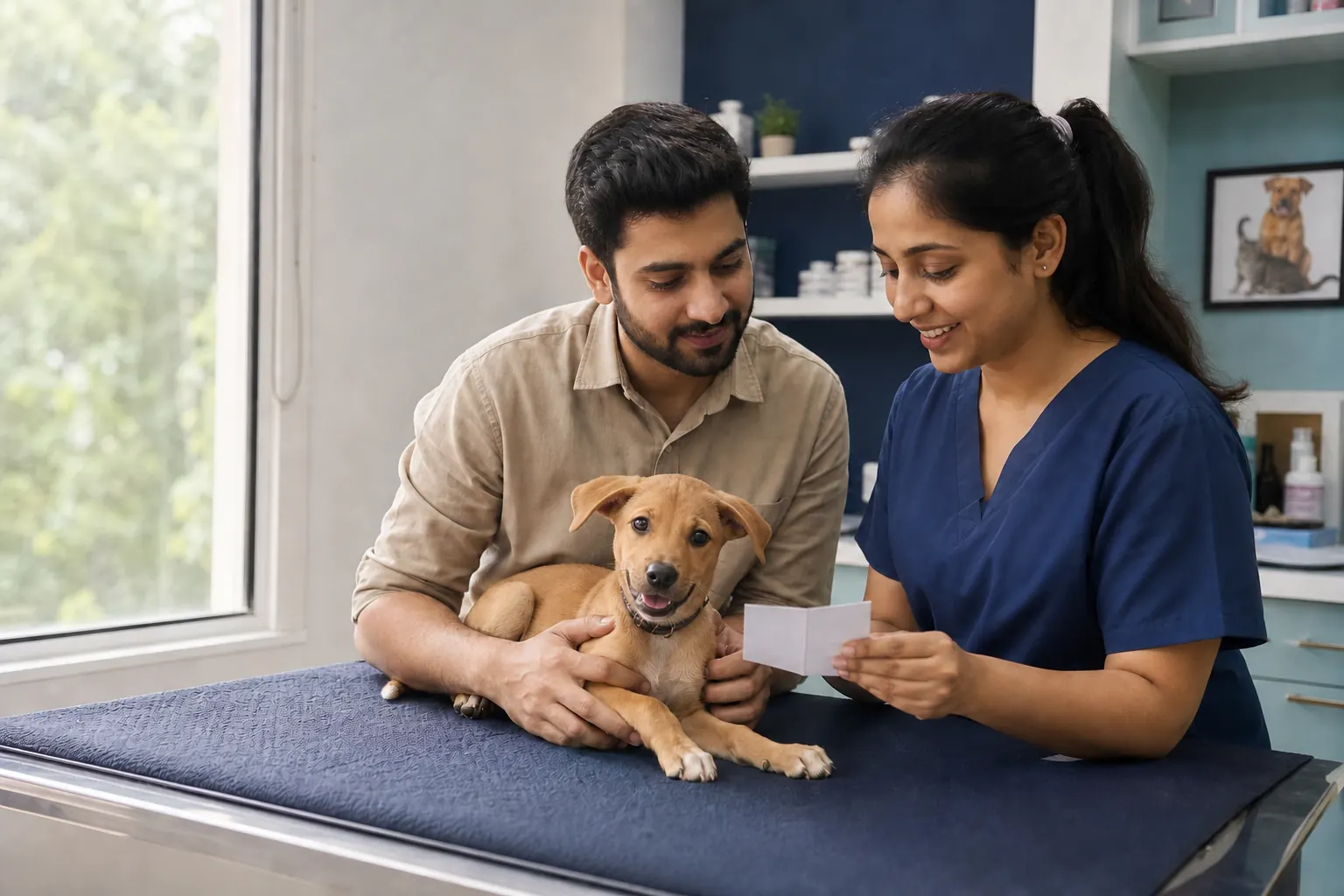
Puppy vaccination schedule chart: 6 weeks to 16 weeks and beyond
A puppy and dog vaccination schedule begins during puppyhood and should be built by a veterinarian. Current global guidance places canine distemper, parvovirus, and adenovirus among the core protections for puppies. The conventional core series starts no earlier than six weeks and repeats every two to four weeks until at least sixteen weeks because antibodies received from the mother can block an early response.
Rabies is central in India, where the disease remains endemic, but the locally licensed product and applicable requirements determine the exact timing. For an alert, stable new puppy, a video consultation can be a practical first step: the veterinarian can review the available record, clarify what is missing, map exposure risks, and prepare the correct in-person vaccination visit. The rabies shot itself, its yearly booster, the price and what to do if a street dog bites your puppy are in our rabies vaccine guide for dogs and cats.
| Age | Vaccine | Notes |
|---|---|---|
| 6–8 weeks | First core combination: distemper, parvovirus, adenovirus (CAV-2) | Starts no earlier than six weeks; antibodies from the mother can block an earlier dose |
| Every 2–4 weeks | Repeat core combination | Continue until at least sixteen weeks |
| 16 weeks or later | Final puppy core dose | The dose at or after sixteen weeks is the one that reliably protects |
| About 3 months | First anti-rabies vaccine | NCDC advice for India; the licensed product leaflet and local rules set the exact date |
| Yearly | Rabies booster | Follow the product-specific next date written on the card |
| Risk-based | Leptospirosis · Bordetella and parainfluenza · canine influenza | Decided by exposure: standing water, rodents, boarding, daycare, classes, outbreaks |
Where should you begin with your puppy's vaccine plan?
Begin with the information available today. First collect four facts—estimated age and records, health today, likely exposure, and the task that needs video or hands-on care—then choose the situation that matches your puppy.
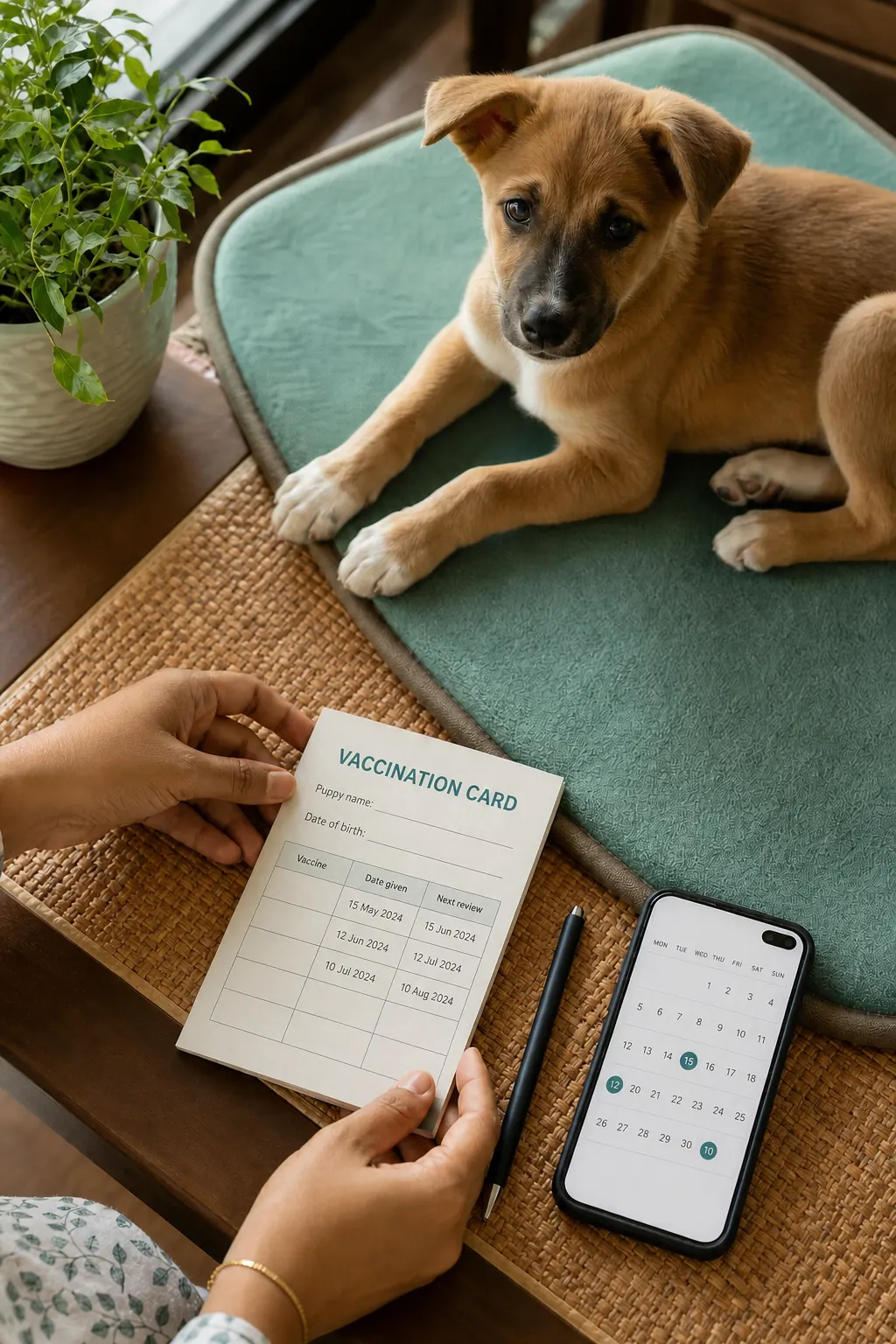
Build a baseline before the first injection
As soon as the puppy joins your home, record the estimated age, source, date of arrival, current health, medicines, living environment, and every available vaccine document.
- Build a baseline before the first injection. As soon as the puppy joins your home, record the estimated age, source, date of arrival, current health, medicines, living environment, and every available vaccine document. What to prepare now: For an alert, stable puppy, use a video consultation to organise the first week and records, then book the in-person examination and vaccination visit recommended for this puppy, at a clinic or at home. Core vaccination usually starts no earlier than six weeks and repeats every two to four weeks until at least sixteen weeks; the product and the puppy determine the actual dates.
- Treat uncertainty as a clinical detail. A verbal assurance or an undated photograph may not confirm the product, batch, age at vaccination, or whether a dose was administered correctly. What to prepare now: Share every paper, label, message, and adoption note. Let the veterinarian build a documented catch-up plan instead of repeating or restarting products yourself.
- Follow the product-specific next date. The important detail is not how many visits another puppy had. It is which product your puppy received, at what age, and when the treating veterinarian wants the next review. What to prepare now: Keep the original card, photograph both sides, and plan only clean, controlled social experiences that fit local disease risk.
- Health comes before the calendar. Note the sign, when it began, whether it is progressing, and the last vaccine product. Do not hide illness to keep a scheduled dose and do not give human or leftover medicine. What to prepare now: Contact the treating clinic before vaccination. Use a physical clinic immediately for breathing difficulty, swelling, collapse, seizure, repeated vomiting, or rapid deterioration.
This planner organises records and questions. It does not prescribe a vaccine, choose an interval, or diagnose a reaction.
Make the appointment more clinically useful
Four preparation steps help the veterinarian individualise the plan and preserve a reliable record.
Carry the original card and source papers
Include vaccine labels, adoption or breeder records, previous reaction notes, and a list of current medicines or supplements.
- Carry the original card and source papers. Include vaccine labels, adoption or breeder records, previous reaction notes, and a list of current medicines or supplements.
- Describe the puppy's health honestly. Mention appetite, energy, vomiting, diarrhoea, coughing, nasal discharge, skin changes, and anything unusual before the appointment.
- Map lifestyle and local exposure. Cover contact with unknown dogs, boarding, daycare, travel, roaming dogs, standing water, rodents, and planned classes.
- Leave with product details and the next review. Check that the card identifies what was given, the batch or lot, expiry, route or site, administrator, and the product-specific next step.
Core, rabies, and risk-based vaccines: what each one is for
A useful schedule names the diseases being covered. Worldwide core vaccines are recommended for puppies because distemper, parvovirus, and adenovirus can cause severe, contagious illness. Rabies is also essential in rabies-endemic India because it is fatal and has major public-health importance.
Other vaccines are selected from the puppy's location, local disease evidence, future boarding or daycare, contact with other dogs, travel, and the products available. These vaccines are not less important when the exposure is real; they are simply chosen for a defined risk.
Vaccination reduces the risk or impact of vaccine-preventable disease; it does not make every exposure safe. Ask the veterinarian to name each disease in a combination product and explain why it belongs in this puppy's plan.
- Canine distemper virus: core protection against a highly contagious disease that can affect the respiratory, digestive, and nervous systems.
- Canine parvovirus: core protection against severe gastrointestinal disease, dehydration, and systemic illness that can be especially dangerous in puppies.
- Canine adenovirus: core protection against infectious canine hepatitis; CAV-2-containing combination vaccines are commonly used to provide this protection.
- Rabies virus: essential protection in India against a fatal zoonotic disease. Timing must follow the licensed product and applicable local requirements.
- Leptospirosis: strongly considered where the disease occurs, relevant serogroups are known, and a suitable vaccine is available. It helps reduce the risk of serious zoonotic bacterial disease that can damage the kidneys and liver.
- Bordetella and canine parainfluenza: considered for puppies likely to attend boarding, daycare, classes, shows, or other close-contact settings; they target vaccine-preventable contributors to canine infectious respiratory disease.
- Canine influenza: considered when local circulation, travel, group housing, or an outbreak creates a credible exposure risk and a suitable product is available.
Maternal antibodies create a moving window
Antibodies received from the mother help protect a young puppy, but they can also neutralise vaccine antigen before the puppy develops a strong active response. They decline at different rates. A puppy can therefore be vulnerable while an early dose is still partly blocked.
The conventional repeated core series is designed around this uncertainty. Do not use an early dose as proof that all exposure is safe, and do not restart or add products without reviewing the record with a veterinarian.
A useful vaccination card identifies the actual product
The record should capture the administration date, vaccine name, manufacturer, lot or serial number, expiry, route, anatomical site, and who administered it. It should also make the next review or expected protection period clear.
Photograph both sides and keep the original safe. If a sticker is loose or writing is unclear, ask the clinic to correct it before you leave. A complete record helps avoid uncertain duplication and preserves information about any reaction.
Keep the puppy's deworming dates on the same card. Deworming runs on its own timetable, set out in the puppy and dog deworming schedule.
Know what changed after vaccination
Local soreness or swelling, quieter behaviour, reduced appetite, fever, or vomiting can occur after vaccination. Ask the clinic what to expect for the exact product and puppy. Record any change and contact the veterinary team if it concerns you, persists, or worsens.
Do not give an antihistamine, human painkiller, old prescription, or other medicine unless the treating veterinarian has assessed the puppy and specifically advised it. Keep the vaccination card available so the product and batch can be identified.
Go to a physical veterinary clinic immediately
Do not wait for an online appointment if any of these signs appear after vaccination or while the puppy is completing the series:
- Difficulty or noisy breathing, or swelling of the face or throat
- Widespread hives, collapse, seizure, or marked unresponsiveness
- Repeated vomiting, water not staying down, or severe weakness
- Bloody diarrhoea, a swollen painful abdomen, or rapid deterioration
Do not try home medication. Take the vaccination card and travel to a physical veterinary clinic.
Online when it can be. In person when it must be. Connected throughout.
For an alert, stable puppy, an online veterinarian can help from the first days at home—before uncertainty turns into a copied schedule or an avoidable exposure.
Start the plan online
- Review the puppy's source, estimated age, health, travel, and exposure history
- Read the vaccination card and labels on camera and identify missing information
- Explain the core-series logic and build questions about rabies and locally relevant vaccines
- Review the home setup and plan lower-risk first-week socialisation
- Prepare the in-person vaccination visit and keep follow-up observations connected
What still needs a clinic
- The puppy needs a hands-on examination or a vaccine must be administered
- Illness or a significant post-vaccination reaction needs physical assessment or diagnostics
- Any emergency sign needs immediate stabilisation
Frequently asked questions
What is usually the first vaccine for a puppy?
Many puppies begin with a combination covering the worldwide core viral diseases: distemper, parvovirus, and adenovirus. The exact product, age, and components must be checked by the veterinarian. Rabies and locally relevant vaccines are scheduled according to the product and risk assessment.
Which vaccines are core for puppies?
WSAVA identifies distemper, parvovirus, and adenovirus as worldwide core canine vaccines. Rabies is core where it is endemic, which makes it central to a plan in a rabies-endemic area. Leptospirosis should be treated as core where the disease occurs, implicated serogroups are known, and a suitable vaccine is available; respiratory vaccines remain based on exposure risk.
What if my puppy has no vaccination record?
Do not rely on memory or a seller's verbal assurance. Share every available paper, label, message, or adoption note with a veterinarian, who can build a documented plan from the puppy's estimated age, health, exposure risk, and locally available products.
When can my puppy go outside after vaccination?
Careful socialisation can begin before the core series is complete, but exposure should be controlled. Ask about local disease risk, use clean settings with known healthy dogs, and avoid unsanitised high-traffic dog areas and shared bowls until advised otherwise.
When should a puppy receive a rabies vaccine in India?
India's National Centre for Disease Control advises a first canine anti-rabies vaccination at about three months and yearly thereafter. WSAVA also says local rules and the licensed product leaflet take priority. Ask the veterinarian to write the exact product-specific next date on the card.
Start with a plan before the first in-person visit
For an alert, stable puppy, a Vetezy video consultation can turn scattered records and questions into a clear first-week plan: what to collect, what to avoid, how to socialise carefully, and how to prepare for the in-person vaccination appointment.
Talk to an expertThis content is for general educational purposes and does not replace a veterinary examination, diagnosis, or treatment. If your pet shows emergency signs or is seriously unwell, contact a physical veterinary clinic immediately.
Clinical references
- World Small Animal Veterinary Association: Vaccination Guidelines
- World Small Animal Veterinary Association: Dog vaccination guidance
- American Animal Hospital Association: Core and risk-based canine vaccines
- National Rabies Control Programme, Government of India
- American Veterinary Society of Animal Behavior: Puppy socialisation
Socialise your puppy while vaccine protection is still developing
The first three months are an important period for learning about people, sounds, surfaces, handling, and other animals. Keeping a puppy in complete isolation until the vaccine series ends can miss useful experiences, but socialisation should be planned around the puppy's current protection and local parvovirus, distemper, and rabies risk.
Start with controlled experiences at home: gentle handling, household sounds at a comfortable level, clean surfaces, visitors who follow hygiene rules, and calm observation without forced contact. If you are considering a puppy class, ask about its entry requirements, cleaning process, class size, and how unwell puppies are excluded.
Until the treating veterinarian advises otherwise, avoid dog parks, shared bowls, pet-shop floors, muddy dog-heavy common areas, and direct contact with dogs of unknown health or vaccination status. This is not 'no socialisation'; it is lower-risk socialisation while immunity develops.
An online video consultation can help a new pet parent review the home setup, the puppy's age and records, planned outings, and first-week routine before the in-person vaccination visit, whether it is arranged at a clinic or at home.