

A dog skin infection in monsoon weather can start with a small change
Extra scratching, redness, a damp patch, scabs, an unusual smell, or local hair loss can be the first clue. Rain does not create one single ‘monsoon infection’, and appearance alone cannot show whether the cause is bacterial, fungal, parasitic, allergic, or something else.
After a wet walk, dry the coat thoroughly and check hidden areas calmly. For a stable dog with a visible skin change, a video consultation is a practical first step. A painful, spreading, oozing, foul-smelling, or recurring patch may need a physical examination and dermatological work-up. Do not guess the diagnosis or apply a human antifungal, steroid, antibiotic, pain-relief cream, harsh antiseptic, or essential oil.
What can you see right now?
It will help choose the safest next step. Select every sign that applies.
- Select any signs you can see. Your safest next step will appear here.
- Keep checking for change. Dry the coat and recheck hidden areas. Seek help if the patch grows, hurts, smells, oozes, or your dog seems unwell.
- Start with an online veterinarian. Photograph the area in natural light, keep it dry, prevent repeated licking safely, and use video to plan monitoring or follow-up.
- Book a video consultation promptly. A veterinarian can review the visible pattern and overall condition, assess urgency, and guide the safest next step.
- Contact a physical veterinary clinic immediately. An emergency sign is selected. Arrange hands-on care now; do not wait for an online appointment.
Six places dampness and friction can hide
Move slowly and stop if your dog shows pain. Tap a number to see what to check.

Look around the ear base and beneath natural folds for dampness, redness, smell, or rubbing.
- Ears and facial folds. Look around the ear base and beneath natural folds for dampness, redness, smell, or rubbing.
- Neck and collar area. Remove wet gear and check the entire contact line. Let both the coat and equipment dry.
- Armpits. Lift each front leg gently. Warm, thin-skinned folds can stay damp after the outer coat feels dry.
- Belly and groin. Check for redness, licking, bumps, or moisture where the skin is thin and less hairy.
- Paws and toes. Pat between the toes and look around nail folds without forcing or repeatedly probing a sore paw.
- Tail base. Part the coat and look for dampness, flea dirt, crusts, or repeated chewing near the tail base.
Which description is closest?
Different diseases can look similar. Use these examples to describe the change clearly to a veterinarian.
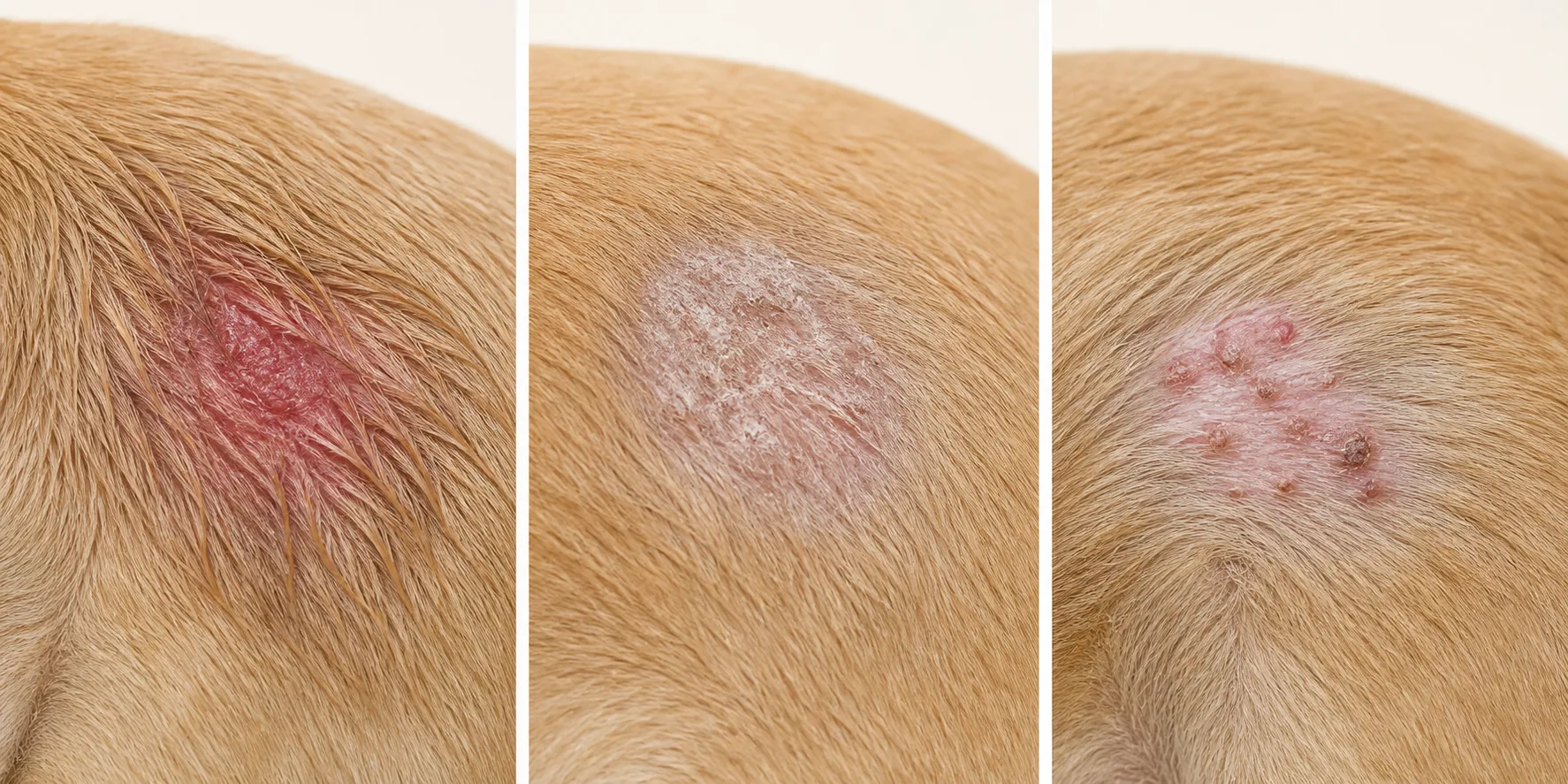
A warm, wet, raw-looking patch
A hot spot or another inflamed lesion is one possibility, especially when licking keeps the area moist. Different causes can share this appearance.
- A warm, wet, raw-looking patch. A hot spot or another inflamed lesion is one possibility, especially when licking keeps the area moist. Different causes can share this appearance. Safest next step: Keep the area dry and book a video consultation so the veterinarian can assess urgency and guide the next step.
- Scale, crust, or a circular hairless area. A fungal condition is one possibility, but bacterial disease, mites, allergy, and other disorders can resemble it. Safest next step: Avoid sharing grooming tools and show the pattern during a video consultation. Testing can be added if the possibilities cannot be distinguished visually.
- Small raised spots, pustules, or surface crusts. These changes can occur with bacterial follicular disease and several other problems. Do not squeeze or scrape them. Safest next step: Photograph the pattern and arrange veterinary assessment, particularly if several areas are involved or the dog is uncomfortable.
These are educational visual clues. Real conditions can overlap, and a veterinarian decides whether examination or diagnostic sampling is needed.
A four-step dry-and-check routine
The goal is to remove trapped moisture without scrubbing or irritating the skin.
Pat the coat dry
Use a clean absorbent towel. Pat instead of rubbing hard, especially over a tender area.
- Pat the coat dry. Use a clean absorbent towel. Pat instead of rubbing hard, especially over a tender area.
- Part a long coat gently. Separate the fur with your fingers so dampness near the skin is not missed. Do not tug tight mats or clip a painful lesion at home.
- Check folds, paws, and gear lines. Look between toes, under the collar or harness, around skin folds, and at the belly, groin, armpits, ears, and tail base.
- Remove wet equipment. Leave the collar or harness off until both the equipment and the coat beneath it are dry. Wash and fully dry reusable towels.
Rain is part of the story—not the diagnosis
Healthy skin acts as a protective barrier. During monsoon weather, a thick or matted coat may remain damp close to the skin, folds and toe spaces can trap moisture, and a wet collar or harness can rub repeatedly.
Allergies, fleas, mites, and other triggers may start itching. Scratching, chewing, and licking then damage the skin barrier and keep the area moist. Bacterial or yeast overgrowth can follow as a secondary problem.
That is why treating only the visible patch may not prevent recurrence. A veterinarian may need to investigate the trigger as well as the inflamed or infected skin.
Why ‘it looks fungal’ is not enough
Redness, scaling, crusts, hair loss, bumps, itching, and odour overlap across bacterial disease, dermatophyte infection such as ringworm, parasites, allergies, and irritation. Even a circular patch is not proof of ringworm.
An online veterinarian can review the distribution, progression, photographs, itch pattern, and relevant history. This helps organise the different possibilities and plan appropriate follow-up.
- Bacterial skin infection is often secondary to another trigger.
- Ringworm can spread between animals and people, but appearance alone cannot confirm it.
- A steroid-containing product can change how some diseases appear.
What not to put on a suspicious patch
Dogs lick their coats, so an applied product can become an ingested product. The wrong treatment can irritate the skin, hide useful diagnostic clues, or delay appropriate care.
- Human antifungal, steroid, antibiotic, pain-relief, or combination creams.
- Dettol, floor cleaner, bleach, concentrated antiseptic, or surface disinfectant.
- Essential oils, kerosene, vinegar, or other home-remedy mixtures.
- Leftover pet medicine from an earlier skin problem.
- Tight bandages that trap moisture over an oozing area.
Contact a physical veterinary clinic immediately
Skin changes are not usually the whole emergency. The dog’s breathing, responsiveness, bleeding, and overall condition determine the urgency.
- Facial swelling together with difficulty breathing
- Collapse, severe weakness, or poor responsiveness
- Rapid worsening while the dog appears seriously unwell
- Major trauma, uncontrolled bleeding, or extensive tissue damage
These signs may require emergency stabilisation. Do not wait for an online appointment.
How an online vet can help with a dog skin problem
For a stable, visually assessable skin concern, a video consultation can be the first clinical step. The veterinarian can assess the pattern, guide safe immediate care, and plan monitoring or follow-up.
How an online vet can help now
- Review the history, environmental triggers, and previous episodes
- Assess lesion distribution and progression from well-lit photographs and video
- Observe licking, behaviour, and visible discomfort at home
- Guide safe immediate care and explain the next step
- Compare changes over time and support follow-up
A task that may be arranged separately
- Laboratory sampling or a procedure when clinically indicated
Frequently asked questions
Can rain cause a skin infection in my dog?
Exposure to rain does not guarantee a skin infection. However, trapped moisture, friction from wet gear, parasites, allergies, and repeated licking can damage the skin barrier and contribute to skin problems.
Can I use a human antifungal cream on my dog?
Do not apply a human antifungal cream simply because a patch looks fungal. Several conditions can look similar. Ask a veterinarian to identify the likely cause and recommend an appropriate plan.
Should I bathe my dog after every rainy walk?
Not automatically. A clean-water rinse may help after dirty-water exposure, but repeated shampooing can irritate some dogs and does not replace thorough drying.
Can I identify ringworm from a circular patch?
No. Ringworm can cause hair loss, scale, or crusts, but bacterial disease, mites, allergy, and other conditions can resemble it. Testing helps distinguish them.
Can I start with a video consultation for a dog skin problem?
Yes, when your dog is otherwise stable and the change can be shown clearly. An online veterinarian can review the history and visual pattern, guide safe immediate care, and plan monitoring or follow-up.
Show the pattern, not just the closest label
Take one photograph showing where the patch is and one close image in natural light. Start with a Vetezy video consultation so the veterinarian can review the pattern and guide the next step.
Talk to an expertThis content is for general educational purposes and does not replace a veterinary examination, diagnosis, or treatment. If your pet shows emergency signs or is seriously unwell, contact a physical veterinary clinic immediately.
Clinical references
- MSD Veterinary Manual: Pyoderma in Dogs and Cats
- Cornell University College of Veterinary Medicine: Hot spots
- American Animal Hospital Association: Why Is My Dog Itchy?
- MSD Veterinary Manual: Dermatophytosis in Dogs and Cats
- CDC: One Health and Fungal Diseases
- AAHA/AVMA: Telehealth Guidelines for Small-Animal Practice